With the end of the year fast approaching every analyst, research, and investment firm is rushing to get their 2022 Outlooks into the hands of advisors and investors. There will be predictions about everything including where interest rates and inflation are headed, what is going to happen in the stock and bond markets, and which countries around the world will flourish or flounder. These forecasts have the same accuracy as Miss Cleo’s psychic predictions that we all remember from TV programming in the 90’s or the famous Zoltar Fortune Teller machine from your local Spring Fair.
With more-and-more people around the world being connected by the internet everyday, the world changes quickly. The amount of information that gets exchanged per second is hard to wrap your head around, and it is only getting faster and faster, but this doesn’t stop economists and market strategists from issuing ‘precise’ forecasts for the year ahead. A few may be right but this is simply due to chance because of the vast number of firms that come out with these predictions. It’s like choosing lottery numbers, if enough people buy lottery tickets then someone will ‘predict’ what the numbers on the upcoming draw will be.
Reuters has compiled 6 of the major Wall Street firm’s predictions for the end of 2022 S&P500 target and they are as follows (from highest to lowest).
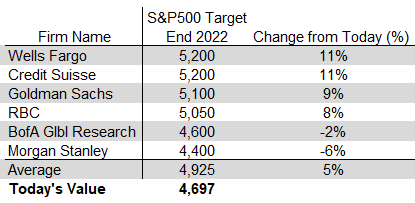
At the time of this writing, the S&P500 currently has a value of 4,696.56 meaning that the average prediction across these firms sees the S&P500 increasing by about 5%. The highest predictions are suggesting a 11% increase from today’s values and the lowest prediction is suggesting a negative 6% return. Will any of them be correct? Maybe, but no one can predict what will happen in the market tomorrow, let alone the value that it will have in over one year’s time.
I want to rewind a couple of years, which would have been December 2019, and I want to bring up some of the headline predictions for 2020:
RBC – New Year 2020 outlook : Boosting equity allocation as economy stabilizes, downside risks diminish
Wells Fargo – Recession risks in the rearview mirror, but a correction could be coming
BofA – 5 key trends will drive stocks next year
Goldman Sachs – 2020 election outcome a risk to equities
Credit Suisse – Cyclical leadership
Morgan Stanley – U.S. remains our least preferred region
Not a single firm suggested that a global pandemic would shut down the entire world. No one said that we would all be forced to shelter in our homes and hope that we did not succumb to a new type of corona virus. Not one headline about the S&P500’s shortest bear market in history (1.2 months), starting on February 20 and ending on April 7, and that we would experience some of the largest daily percentage losses in history (-12% on March 16 and -9.5% on March 12). Regardless of the bear market, the S&P500 still went on to achieve a positive return of 16% for the year. No one is holdings these firms accountable for missing this major world event because no one can expect anyone to predict something that is seemingly unpredictable, no matter their level of expertise on any subject. That being said, I still have friends and clients that ask me to pass along these predictions as I receive them, like it is something that they can use to make their own predictions for the upcoming year and turn them into better investors. I believe that these will actually leave you worse off as an investor because you’ll have some false confidence that you know what’s coming. The best thing you can do is realize and embrace the fact that the world is unpredictable, resulting in the markets being unpredictable in short periods of time.
The only solution that I have found to provide any sort of prediction of what the future holds is through long-term financial planning. Don’t try to forecast one year ahead because any funds that are required within one year shouldn’t be invested, unless you can afford the potential loss of needing the funds when the market is down. Forecast ten or twenty years and use long-term multi-decade averages for the assumptions within the plan. The average’s for the assumptions should encompass different periods of market & economic cycles. Creating the plan is step one, but the job is far from over. Planning is only valuable when it is revisited to quantify where you stand based on your goals. Are you still on track? Has anything changed in your life that requires a re-work of the plan? We know that the world is unpredictable and our lives are no different so make sure that you are focusing on the right tools to forecast your own personal success.
Want to chat about it? Email me at info@financerx.ca
 Finance RX
Pingback: An Experienced Captain is the Best Way to Weather Economic Storms | Finance RX