This comment comes up sometimes when I discuss a client’s cash reserves that are not flagged for something specific in the short-term. This can lead to “analysis paralysis” – where so much energy and time is spent comparing and evaluating variables that no action is actually taken. As humans, sometimes we are so scared to make the wrong decision that we would rather not act at all. The problem with this is that you may be providing yourself with comfort today by reducing the chance of a temporary loss of value but you may be giving up comfort in your future by losing out on any gains that will occur between now and when you actually choose to act.
When these conversations come up then I usually like to go through a bit of an exercise with clients, which is just a set of questions that you can follow along and answer on your own.
- Do you have any need for this money in the short-term (1 – 5 years)? The answer to this question is usually no, or else we wouldn’t be talking about investing these funds into a long term solution.
- So, you want to wait to invest until the world seems to be settled and world economies look better? What does that kind of world look like to you?
- That sounds like a great time to invest. Now, keeping in mind the type of world that you just described, compared to today where do you think stock market prices would be in the type of world that you are describing?
- As you can probably surmise, everyone answers the last question as “higher.”
Markets are uncertain, the world is uncertain too, and the greater certainty that exists will result in higher asset prices because there are less negative variables working against the positive variables. The object of investing is to buy LOW and sell HIGH and by waiting to invest until the world is less volatile and more certain then you can almost guarantee that you will have to buy at higher price levels.
J.P. Morgan has put together a chart of the Consumer Confidence Index and the subsequent 12-month S&P500 returns from January 1971 to March 2022:
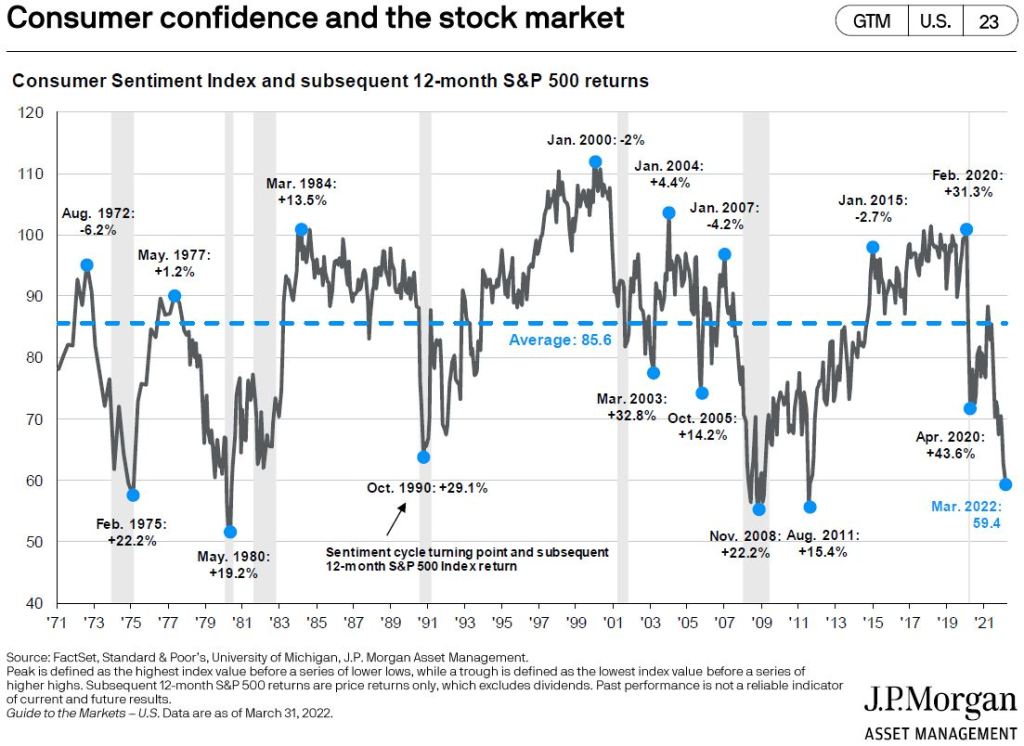
The chart shows us that when consumer confidence is high and there is a turning point in sentiment then the S&P500 usually does not provide much of a return in the following twelve month period. The outlier in this observation is February 2020 (the onset of the global COVID pandemic), when confidence was high and the market provided a one year return of 31.3%. I believe the reason for this outlier is that consumer confidence definitely turned negative after February 2020 but the unprecedented economic stimulus of governments around the world resulted in financial markets remaining strong. If you look at the negative points on the chart that represent a change of sentiment to more positive values then you can see that the resulting twelve month returns of the S&P500 are much higher. Currently, consumer confidence is low (59.4 compared to an average of 85.6) but no one knows if we are at a turning point today or if it will come tomorrow, next week, or next year.
What I will say is that I’d rather continue to purchase shares in the great companies of today when confidence is low and uncertainty is high than the opposite. If your situation is the opposite, requiring income from your portfolio, then there are different strategies that exist to get you through these low-confidence periods of time. It could be as easy as putting aside a certain amount of cash, between 2 to 5 years, so that you can have the piece of mind that you do not need to sell shares of your existing portfolio at depressed prices to provide you with your required income.
In closing, I could never say it better than some quotes from The Great Warren Buffet.
“Today people who hold cash equivalents feel comfortable. They shouldn’t. They have opted for a terrible long-term asset, one that pays virtually nothing and is certain to depreciate in value.”
“I will tell you how to become rich. Close the doors. Be fearful when others are greedy. Be greedy when others are fearful.”
Want to chat about it? Email me at info@financerx.ca.
 Finance RX