Don’t Believe the [Negative] Hype

As humans, we have ancient mental traits that helped us survive a millennia ago but now these same traits often just get in the way. Imagine yourself living in a cave, as one of your ancient ancestors, and you’re preparing to go on a hunt but something seems off. You are hearing noises outside that deter you from wanting to leave the comfort of your “home.” You have two choices: Leave the safety of your cave and risk death; or skip the hunt, go hungry, and wait for the potential danger to pass. The majority of people would rather stay home to live another day.

The next day, the cognitive rollercoaster isn’t over yet as, most people would have an increased sense of nervousness when they attempt to leave the cave. But now there will also be another negative thought that combats the nervousness, they will have an added fear of failure that will start to seep into their mind. When that fear of failure overtakes the fear of the outside then they will leave the comfort of their home and venture into the unknown, albeit on edge and with heightened senses.

Humans have evolved over hundreds of millions of years to pay extra attention to negative experiences (especially life and death situations) by reacting to them intensely, remembering them well, and over time becoming even more sensitive to them.

What does this have to do with you, today? We can think of a similar situation albeit more modern. Imagine you’re driving on the highway and someone cuts you off and narrowly misses you. You slam on your brakes and feel a tense feeling of anger rise up within you. This sort of feeling is one that can stay with you and can eventually ruin your whole day. You might be less productive or distracted, which only compounds the problem. This experience might stay with you for awhile and effect your driving habits for a period of time after the actual event.

Why does one negative experience ruin an otherwise great day?

Why does this experience have such a powerful effect on us?

Why is it that this experience of short-term unhappiness is invested into long-term unhappiness?

Research has proven that our brains have evolved to react much more strongly to negative experiences than positive ones. This negativity bias can influence how we feel, think, and act, and can have some undesirable effects on our psychological state.

We can think about this in the context of investing and investment news. A downturn in the markets creates the same fear response as the examples above. This response might have saved the life of your ancestors but the market isn’t influenced by your behavior and a bear market isn’t a life-threatening situation. Don’t get me wrong, this year it has been very difficult to be an investor with the S&P500 currently sitting at a loss of 24% year-to-date, but I bet that you don’t remember that this same market has provided investors with returns of 27%, 16%, and 29% over the course of 2019, 2020, and 2021, respectively. People tend to forget that the average annual return of the S&P500 in USD over the course of the last 100 years, but also the last 40 years, equates to around 10% per year and this accounts for every bear and bull market that we have experienced along the way.

Modern news agencies spend thousands of dollars on studies to examine what keeps your eyes on the screen and they know how to tap into our primal negative bias instincts. You’ll watch more if the market pundits talk about how the sky is falling or today’s Armageddon-du-jour. You watch more because you believe that they are going to present you with a secret that no one else knows but this is simply useless noise. The headlines are not actionable and is far from being personalized to your own specific situation. A bear market to someone accumulating assets is very different than to someone who is decumulating assets. The news agencies know just as much as the rest of us, no more about the future than you or I. It’s a lot easier if you simply come to terms with the fact that the market is uncertain, but without uncertainty then there would be no opportunity. There are factors that you can control like your level of tolerance to investment losses, such as the percentage of equities in your portfolio and your level of diversification.

Another way to get through these periods of time is by creating a financial plan to achieve your goals. People have a hard time planning though because, just like the market, the future is also uncertain. Think about all of the unexpected turns your life has taken and the possibilities that those turns have opened up. While you couldn’t have predicted the outcomes of the decisions you have made, you know how to gauge your feelings about the risks and opportunities being presented to you. The same goes for planning; you are making the best guess at present for the future and the longer the time horizon that you are trying to plan for will increase the potential variance of the outcome. You have to deal with factors that are out of your control, such as the return of the markets, interest rates, exchange rates, and other worldly factors but also personal factors like moving, changing careers, or births and deaths in your family. The longer the time that you are trying to plan for then the increasing probability that your outcome will be incorrect. This is the reason that plans are useless but the repeated planning process is invaluable. It allows you to set a course, which will be correct for a period of time, but then will require regular course corrections to account for broad market changes, personal life changes, and changes to your goals.

If you’ve done the best you can then go easy on yourself. It’s not the decisions you make, but how you make decisions. Investing, like life, is a process. If you have a plan and follow that plan then you’ve put yourself in the best position to achieve success. Try to do your best not to fall prey to your primal instincts of being negatively biased. Don’t dwell but learn from your disappointments and celebrate your successes.

Email me at info@financerx.ca.

An Experienced Captain is the Best Way to Weather Economic Storms

For the 2021 Calendar Year

Canadian Inflation was 4.8% in December 2021

S&P U.S. Aggregate Bond Index returned -1.4%

S&P Canada Aggregate Bond Index returned -2.48%

S&P500 returned 28.71%

S&PTSX60 returned 28.05%

FTSE Developed All Cap ex North America returned 9.1%

As of July 27, 2022…

Canadian Inflation rose to 8.1% in June 2022

S&P U.S. Aggregate Bond Index is down -8.38% YTD

S&P Canada Aggregate Bond Index is down -8.94% YTD

S&P500 is down -15.58% YTD

S&PTSX60 is down -9.44% YTD

FTSE Developed All Cap ex North America is down -17.90% YTD

Imagine you are relaxing in a boat and it is a very calm day on the water, barely a ripple. You are really enjoying your time, soaking in the sunshine, and can’t fathom how your situation could change. Now, imagine one or two waves start to hit the side of the boat. Even though these waves are still quite small, you are accustomed to mirror-flat water so even small waves can feel huge. These waves continue to grow and grow into storm-sized waves and a lack of experience captaining a boat during severe storms can put you in a dangerous situation. During these times, the best thing that you can do is batten down the hatches, remain calm, and whatever happens do not abandon your ship.

This is a great metaphor to help explain the vastly different results from 2021 and 2022 YTD. Everyone was quite happy at the end of 2021 after high-return, low market-volatility year and most financial firm analysts were predicting greater volatility but nothing out of the ordinary and continued positive returns. This is the main reason that I don’t let any market outlooks weigh into my decision-making as a wealth advisor. Analysts can make educated guesses but, in the end, it is still a guess and anything can happen. I write about this in a previous article from December 22, 2021 titled “Forecasts & Fortune Tellers.” So, back to the example, what were believed to be seemingly small issues, that were thought to be transitory, at the end of 2021 acted as the beginning ripples that led us to the storm waves that we have so-far experienced in 2022.   

2022 has been the result of multiple global events to get us into this situation; China’s zero-Covid policy, Russia’s invasion of Ukraine, and a pandemic legacy of over-monetary and fiscal stimulus has led to supply-chain disruptions, commodity shortages, and excess demand igniting inflationary pressures not seen since the 1970s. A diversified portfolio is (usually) one way to minimize negative markets. Markets normally work in a way that if one asset falls then another usually rises, which acts to stabilize the portfolio. However, diversification has its limits. When everything goes down together, there is little that can be done to protect the portfolio. Even hiding out in cash is a guaranteed losing bet when inflation is running in the high single digits. I’d rather give myself a chance to beat inflation by investing my long-term money in the great companies of today at sale prices rather than guaranteeing an after-inflation loss by hiding out in cash.

This is one of the most difficult ideas to grasp as an investor. It can seem like the world is coming down all around you and, as a long term investor, these are the times that you should be trying to deploy excess cash into the market because the potential upside return is higher when markets are down than when they are continually achieving new all-time highs.

It’s also completely okay if you don’t have extra funds to invest when markets are down but, as long as you are invested in a globally-diversified portfolio, you should stay the course at this point. Major changes to your investment portfolio should have been done when the market was still achieving all-time highs. Remember earlier when we thought of ourselves relaxing in the boat? Now is where you should have already battened down the hatches and are remaining calm. Your boat is your only savior during the storm, your boat has experienced lots of storms like this in the past and it was continue to experience lots more storms like this in the future. Whatever you do, do not abandon ship.

If you ever feel like you need some help at the helm of your boat (portfolio) then do not hesitate to reach out below. I’ve experienced many storms, just like this one, in the past and I’ve made sure that none of my clients have ever abandoned ship at the wrong time.

Email me at info@financerx.ca.

Spring 2022 : Hibernation Ends for the Bear [Market]

The S&P500 had a value of 4,796 on January 3, 2022, which marks the highest value achieved by this index. It took until June 13, or 161 days, for the bears to overtake the bulls and pull the market down over the -20% mark (or a value of 3,837). The reason for the decline on Monday, June 13 was in result of a higher-than-expected inflation report in the US, which may require the US to raise interest rates more aggressively than expected.

Think of the US Fed like a high-wire tightrope walker; they must balance their actions accordingly or else they will fall and the US economy will find itself in a recession. If they do not move interest rates higher, quick enough then inflation will continue its upwards trajectory, which means higher prices for products and services, and will require that the Fed is more aggressive with future interest rate hikes, which will put added strain on asset prices and the credit market. If they move interest rates too high and too fast for the current state of the US economy then the higher rates will backfire and the US will find itself in a recession.

If I can provide any advice during this time, it is to avoid listening to mainstream media and focus on the things that you can control during this period of time.

Play Dead (avoid costly knee-jerk reactions)

Use Emergency Cash for Income Needs (if you are reliant on income from your portfolio)

Keep Investing (this is an opportunity if you are still savings for the future)

Revisit your Goals and Risk Tolerance with your Wealth Professional

Use the Volatility to Rebalance your Portfolio

STAY CALM

This isn’t anything new and we can look back at history to find that the average decline in a bear market is negative 30% and the average duration is around 13 months. As of now, the 2022 bear market has a current return of negative 22% and has a duration of around 5.5 months. This particular bear market may already be on the path to recovery or we may experience further declines from here but, remember, the values on your screen/statement are only your values if you make the (short-sighted) decision to sell.

Want to chat about it? Email me at info@financerx.ca.
High Inflation & the Argument for Delaying the Payment of “Good” Debt

Unless you have been living under a rock in 2022, you will have first-hand experience dealing with the level of inflation that is plaguing many developed nations. Canada’s inflation rate, currently 6.8% based on April’s metrics, is the highest level since January 1991.

Inflation, in a nutshell, is defined by the lost value of currency over time. Using Canada’s current inflation rate as an example, it means that if you had $1.00 in April 2021 then you actually would need between $1.06 – $1.07 in April 2022 to purchase the same amount of items that your loonie was able to purchase in April 2021. It can seem negligible when you are talking about loonies and cents but it becomes substantial when you start talking about larger dollar figures or its effect over longer periods of time.

For informative purposes, Canadian inflation has averaged:

2.24% over the last 5 years

1.8% over the last 10 years

1.93% over the last 20 years

3.52% since 1950

So, let’s look at an example based on the different annual inflation rate averages from above. You can see that the greater the rate of inflation then the greater loss of purchasing power over time. If inflation was to stay as low as 1.8% then, after 30 years, you would be able to purchase about $0.58 worth of goods. If inflation was to stay as high as 3.52% then, after 30 years, you would be able to purchase about $0.34 worth of goods.

I spoke about inflation and the corresponding risks to the majority of Canadians who will be required to create a retirement income for themselves previously. The article was written in October 2021 and was titled, “The Invisible Thief,” and you can find it here.

When you look at inflation and its effects on debt then the relationship gets interesting. Before I jump into any analysis, I want to discuss the differences between “Good” Debt and “Bad” Debt. Investopedia summarizes these terms by suggesting that Good Debt has the potential to increase your net worth or enhance your life in an important way and Bad Debt involves borrowing money to purchase rapidly depreciating assets (eg. a new car) or only for the purpose of consumption (eg. travel). Good Debt usually has low and attractive interest rates and Bad Debt usually has higher interest rates and should be paid off as soon as possible, but this relationship doesn’t always exist. Everyone’s emotional response to debt is different so I am not advising anyone to act on any information within this article other than for informative purposes to make their own decision with the help of a professional.

While we are working in our careers, most workplaces will increase the income of staff every year by some percentage (usually around 2% – 3% by default to account for inflation). If your income does not increase then, effectively, your employer is awarding you with an annual reduction in income.

Imagine you take out a loan that lasts 30 years, and every month, you owe $100. Regardless of what happens with your income and inflation, you still owe $100 per month over the course of the loan. As time goes on, the payment of $100 means less and less to you because the value of a dollar diminishes over time. It doesn’t matter to your lender that your income increases over time, the only thing that matters is that the lender continues to receive their minimum payments and you do not break the terms of the loan.

This does not mean that you should only pay the minimum payment amount on debt and spend the rest frivolously. It means that it may make more sense to take any extra funds that you were allocating to debt, over and above the minimum payment, and re-allocate these funds into an investment solution. Not any investment solution will work though, remember, if you aren’t earning more than the average rate of inflation over time then you are effectively losing money.

Want to chat about it? Email me at info@financerx.ca.
Markets Take the Stairs Up & the Elevator Down

The S&P500 has declined for seven straight weeks, a streak not broken since the early 2000’s. A bear market is said to begin once an investment or index has a 20% decline in value from the most recent closing high. The S&P500 had a value of 4,796.56 on January 3, 2022 so a value of 3,837.25 equates to the S&P500 bear market threshold value. The S&P500 dropped past the threshold on Friday, May 20 but avoided that fate by recovering some value in the last hour of trading.

There have been 16 bear markets since World War II and they have lasted around 13 months on average. I spoke about the history of bear markets in my article from late November, titled “It’s Not a Matter of If, It’s When…” The last three bear markets (2011, 2018, and 2020) only lasted 5, 3, and 1 month respectively.

The chart below shows the numerous bull and bear markets that the market has experienced from 1926 to 2021. Each separate market also has the number of months it lasted and the achieved return over that time period. The main takeaway is to show how much more blue (bull markets) you can see on the chart than green (bear markets). As well, compare the historical returns achieved during bull and bear markets of the past. We can see that bull markets last much longer than bear markets AND they also achieve much more growth than what is temporarily lost during any bear market.

There are numerous global current events causing 2022’s market volatility. We have central banks from many developed countries trying to combat inflation, which requires accelerated interest rate hikes. The Russian Invasion of Ukraine is still raging on and this has resulted in commodity prices being very close to multi-year highs. China’s strict “zero COVID” policy is forcing strict lockdowns in cities that have the same size as some small European countries and this is continuing to prolong global supply chain issues. These combined factors will continue to be a headwind on global economic growth and stock markets around the world but don’t underestimate the economy and the stock market. This isn’t the first time that we have experienced heightened inflation, war, and pandemics and the market has always had incredible fortitude to look past many examples of major global events and continue to reach all time highs.

The market was able to avoid the bear last Friday but, none the less, if we do not experience it this time then we will for another reason in the future. While it can be scary to invest during periods of time when investment sentiment is as low as it is, it has never been a bad buying opportunity in the past. These periods of market weakness present opportunities as long as you are investing in the right investments and have the patience to allow for a recovery.

Don’t panic.

Invest in diversified solutions for the long term.

Keep enough cash on hand to weather the storm (keeping in mind that the average bear market has lasted around 13 months).

Want to chat about it? Email me at info@financerx.ca.

Staying Warm When the Market is Cold

These days it is not easy being a retail investor. No matter where you look there seems to be negative news everywhere but do not let short-term thinking cloud your long-term judgement. There have been many instances in previous articles that I have talked about market volatility and ensuring you have a plan for market volatility. This is one of those times.

If you are reliant on the income that your portfolio produces then you should have enough cash on the side-lines to get you through a potential bear market. If you don’t have the cash then you could always utilize a credit facility like a line of credit, but this option is contingent on your personal feelings of debt. If you do not have an existing plan then now is the time to start thinking and preparing for a potential bear market and minimizing the amount of shares that you will have to sell if we continue to see further temporary losses.

If you are still accumulating assets then this should be seen as an opportunity. If you are able to, draw in your spending habits and allocate a larger proportion to investment. The S&P500 closed at a value of 3,991 on Monday, May 9, which is a 2022 YTD return of -16%. The last time that the S&P500 experienced this value was at the end of March 2021. Negative market volatility is like having a time machine that can take you back to the past and allow you invest at former levels.

Let’s not forget that this volatility is completely normal and has been expected. The S&P500 has rewarded investors by providing annual returns of 29%, 16%, and 27% in 2019, 2020, and 2021, respectfully. The average annual S&P500 return from 1980 to 2021 is 9.4%. We can’t expect the returns of the past few years to continue every year and we actually should not want them to continue at such high levels compared to the average. The longer that a market continues to experience abnormally higher returns than the long-term average will usually result in a larger than normal downturn at some point in the future. Once this current correction and transition is over, the global economy will likely be in a better position.

Looking at the past 72 years (from 1928 – 2021), on average, the S&P500 has experienced

  • A correction once every 2 years (a decline of 10% from the most recent market high)
  • A bear market once every 7 years (a decline of 20% from the most recent market high)
  • A crash once every 12 years (a decline of 30% from the most recent market high)

In Canada, we experience snow almost every year depending on where you live. Think of our Canadian winter experience like a market correction because it happens almost as often. When we feel our first snowflake of the year, do you start stocking up on food, fuel, and all of the essentials for the next ice age? No, that would be silly, we bundle up and we continue living our life. Your portfolio should be prepared for corrections and bear markets the same way that we have to dig our warmer clothing out of storage for the winter months. We are in the midst of a market snowfall right now but we will get through it and eventually the spring sun will be upon us again.

Want to chat about it? Email me at info@financerx.ca.

“Let’s Wait to Invest”

This comment comes up sometimes when I discuss a client’s cash reserves that are not flagged for something specific in the short-term. This can lead to “analysis paralysis” – where so much energy and time is spent comparing and evaluating variables that no action is actually taken. As humans, sometimes we are so scared to make the wrong decision that we would rather not act at all. The problem with this is that you may be providing yourself with comfort today by reducing the chance of a temporary loss of value but you may be giving up comfort in your future by losing out on any gains that will occur between now and when you actually choose to act.

When these conversations come up then I usually like to go through a bit of an exercise with clients, which is just a set of questions that you can follow along and answer on your own.

  • Do you have any need for this money in the short-term (1 – 5 years)? The answer to this question is usually no, or else we wouldn’t be talking about investing these funds into a long term solution.
  • So, you want to wait to invest until the world seems to be settled and world economies look better? What does that kind of world look like to you?
  • That sounds like a great time to invest. Now, keeping in mind the type of world that you just described, compared to today where do you think stock market prices would be in the type of world that you are describing?
  • As you can probably surmise, everyone answers the last question as “higher.”

Markets are uncertain, the world is uncertain too, and the greater certainty that exists will result in higher asset prices because there are less negative variables working against the positive variables. The object of investing is to buy LOW and sell HIGH and by waiting to invest until the world is less volatile and more certain then you can almost guarantee that you will have to buy at higher price levels.

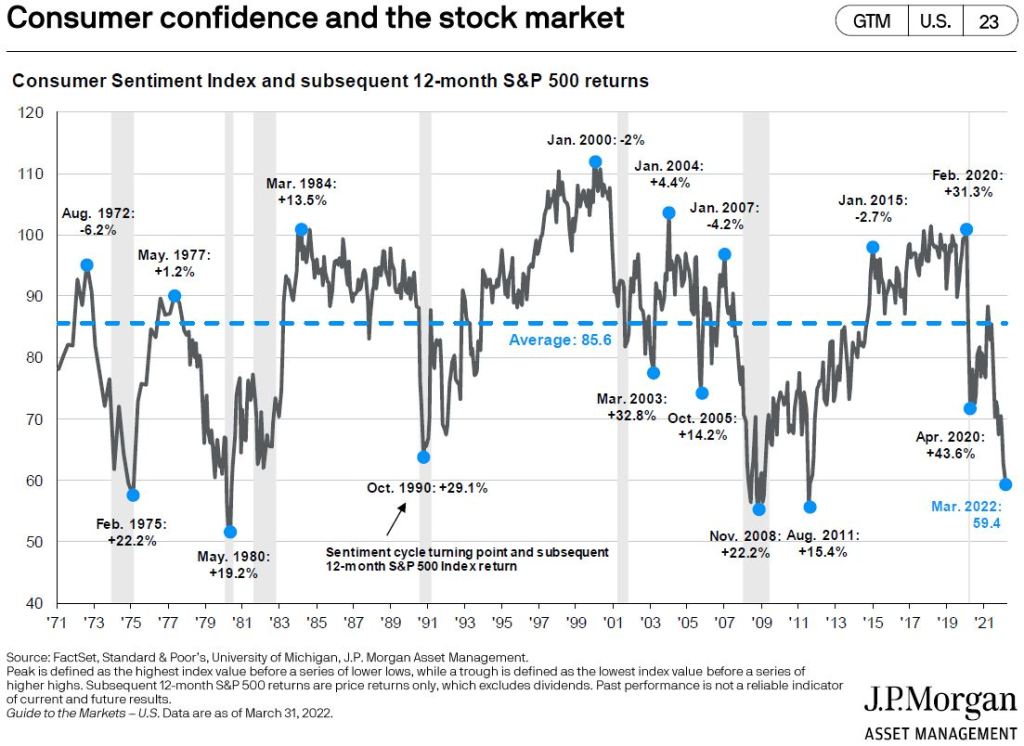
J.P. Morgan has put together a chart of the Consumer Confidence Index and the subsequent 12-month S&P500 returns from January 1971 to March 2022:

The chart shows us that when consumer confidence is high and there is a turning point in sentiment then the S&P500 usually does not provide much of a return in the following twelve month period. The outlier in this observation is February 2020 (the onset of the global COVID pandemic), when confidence was high and the market provided a one year return of 31.3%. I believe the reason for this outlier is that consumer confidence definitely turned negative after February 2020 but the unprecedented economic stimulus of governments around the world resulted in financial markets remaining strong. If you look at the negative points on the chart that represent a change of sentiment to more positive values then you can see that the resulting twelve month returns of the S&P500 are much higher. Currently, consumer confidence is low (59.4 compared to an average of 85.6) but no one knows if we are at a turning point today or if it will come tomorrow, next week, or next year.

What I will say is that I’d rather continue to purchase shares in the great companies of today when confidence is low and uncertainty is high than the opposite. If your situation is the opposite, requiring income from your portfolio, then there are different strategies that exist to get you through these low-confidence periods of time. It could be as easy as putting aside a certain amount of cash, between 2 to 5 years, so that you can have the piece of mind that you do not need to sell shares of your existing portfolio at depressed prices to provide you with your required income.

In closing, I could never say it better than some quotes from The Great Warren Buffet.

“Today people who hold cash equivalents feel comfortable. They shouldn’t. They have opted for a terrible long-term asset, one that pays virtually nothing and is certain to depreciate in value.”

“I will tell you how to become rich. Close the doors. Be fearful when others are greedy. Be greedy when others are fearful.”

Want to chat about it? Email me at info@financerx.ca.

Always Have a Plan but Plan for Change Too

Our lives are rarely static for long periods of time. Change can occur due to outside forces that we can not control or it can occur from a direct choice that we have made so if you continually expect change to occur frequently in your life then it will be less surprising when it occurs. The reason that I bring this up is because my partner and I recently adopted a puppy so the last few weeks have been very different from what we were used to. We have had to change our sleep schedules, our work schedules, our budget, and pretty much everything else that you could think of. The changes are welcomed but, as a financial planner, it means that every prior plan that I have made for our future requires some tweaks to reflect our current situation. Your chosen financial representative should understand this and they should encourage you to contact them to update your plan whenever a material change occurs in your life, especially one that will change your finances. Many different adaptations of your plan will need to be made over the course of your lifetime to reflect the changes that will occur.

Any change to your plan today, no matter how small, will have larger repercussions as you increase the length of time that you are planning for. This is a concept known as, “The Butterfly Effect,” which states that a small change today can lead to vastly different outcomes in the future. The main principle to keep in mind here is time. Time is one of our most valuable assets because it is finite and no one truly knows how much of it they have left. When it comes to investing, the length of time that you have to invest (called your investment time horizon) is going to be one of the most important variables in determining how to invest and what value to expect in the future.

When we are young, we have seemingly unlimited time but finite resources to do the things that we want to do. As we grow older, if we carefully plan, we should have all of the resources required to satisfy our wants and needs but it is time that seems to slip away from us. Time is valuable but its importance only becomes more clear as more of it passes us by. If only we could have told our younger selves to put away those extra dollars or make them think twice about a substantial purchase that was not truly needed. I know that my parent’s tried to do just that but, again, my younger self did not understand this particular relationship with time.

One exercise that I learned during the course of my career to show this relationship in a more tangible way is to think of a meter stick, just like the ones that you remember from your school years. A meter stick is one hundred centimeters long. In 2022, the average life expectancy in Canada is 83 years (rounded) so automatically cut 17 centimeters off the end of the meter stick. Now, think about how old you are today, and place a mental mark on the corresponding centimeter that represents your age. The distance from your mental mark to the new end of the meter stick, at 83 years, is the amount of time that you have left to live, on average. Just before your 21st birthday you’ve already burned up a quarter of your life and the middle of the way through your 41st year you will have reached your halfway point. This exercise can be eye-opening because many of us do not realize how quickly the distance to the end of the meter stick shrinks.

You may have been a late bloomer to have this epiphany about time as a resource but I can tell you that it is never too late to create a vision and a plan to achieve that vision. A plan, no matter how many times you are required to change it, is still the best way to ensure that you have the directions to navigate the tides of time to succeed in achieving the future that you envision. A vision without a plan is just an illusion and a plan without a vision is void of any feeling or emotion.

If you need help creating your own unique vision and subsequent plan then reach out to me at info@financerx.ca & if you are curious about our newest addition to the family, here is a picture.

Who Will You Choose to Have in Your Corner?

Choosing the correct key people in your life is a big decision and is one that you should not take lightly. I’m talking about the person (or persons) that will make sure that your affairs continue to remain in order in the event of incapacitation and thereafter. A lot of people put more emphasis on choosing an executor than a power of attorney but more thought should be put on the latter instead of the former. The reason that I believe this to be the case is that if your power of attorney steps in to assist you then that means you are still living and your well-being will be determined by how well of a job that they do acting as your attorney. Once your executor must step in then you have passed on and what will be, will be.

You have many options for choosing these key people. You can choose family members, friends, or a professional (like a lawyer or a trust & estate corporation). As we know, most people choose family members but do these family members know what they are signing up for? Are they going to be able to do the best job possible if they live elsewhere or if they can not take the necessary time off of work to complete their duties? Most estates do not require a lot of time but it can be very time consuming if there is real estate or other physical-type assets involved (like art, collectibles, etc.).

Generally, a power of attorney does not get paid for their services unless it is written into the legal POA. They have a very important job though, including paying all bills, ensuring all your accounts are kept up-to-date, paying taxes, and buying and selling investments or even real estate. Their job is to make you a priority and ensure that everything that you need is taken care of.

An executor’s job is to secure all assets of an estate and then distribute them according to the deceased person’s wishes. They will follow what you have written in your Will and ensure that everything is dispersed according to your wishes. In regards to a fee, an executor in British Columbia can take as little as 0% but has the option of taking up to 5% of the total estate value. Bear in mind that any accounts that are held Joint with Rights of Survivorship do not pass according to your estate, as they become solely owned by the surviving account owners. Another thing to keep in mind is that any asset (such as a TFSA and RRSP/RRIF) does not have to pass according to your estate if you have named a beneficiary on these accounts at your financial institution.

Here are some things to keep in mind when you are choosing these Key People:

What sort of financial knowledge does this person have? How is their own financial situation?

How old are they today? How old will they be in the future if they have to step into either role?

Are they going to be available for you? Can they take time off of work if it is required?

Now, just because someone has chosen you to act as their power of attorney or executor that does not mean that you have to move forward with it. People need to keep this in mind because as soon as you begin to act as an attorney or executor then you are personally liable for the decisions that you make. You can pass the responsibility on to someone else or enlist the help of a corporation that specializes in these types of roles. All of the Canadian Chartered Banks have Trust & Estate Specialists that focus on these roles and can step in to assist. If you are concerned about any of the responsibilities required then why not enlist a professional? It is a huge responsibility to act as someone’s executor and attorney so think it through before you agree to anything.

Want some help developing your Estate plan? Email me at info@financerx.ca.

Are Your Beneficiaries Per Stirpes or Per Capita?

The creation of an efficient estate plan requires some thought and should be reviewed approximately every five years to ensure that no changes need to be made. I’ve found that most clients did not know that there are two different options when it comes to how estate assets and registered accounts are dispersed, Per Stirpes and Per Capita. Both options look the same up until the moment a beneficiary passes away and then you can see the clear differences.

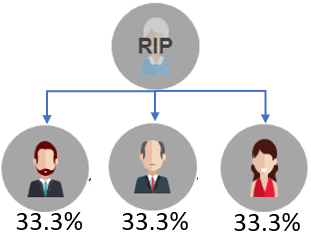
We all know how estate dispersions work but I have created a picture to make it easier (see below). Looking at the estate breakdown below, you will see that someone passed away and the estate is evenly split between three beneficiaries. This means that each beneficiary will receive approximately 33.3% of the total estate. 

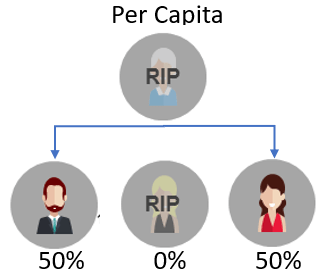
What if one of these beneficiaries happens to predecease the person at the top? If an estate is set up Per Capita, which is the most common, then if one of the beneficiaries were to pass away first then the estate would be distributed evenly amongst the surviving beneficiaries. You will see below that the two remaining beneficiaries now get to evenly split the estate between the both of them and the deceased person’s heirs receive none.

The other option, if one of the beneficiaries happens to predecease the person at the top, is know is Per Stirpes. Per Stirpes means that if one of your listed beneficiaries predeceases you then their portion will pass to their heirs, based on the deceased beneficiary’s Will. The Per Stirpes designation is most common when parent’s would like their assets to pass to their adult child’s family in the event that their adult child predeceases them.

Making sure that your Will and Registered Accounts are set up correctly will ensure that your distribution requests continue to be acted upon as you originally wanted them to be, even if one of your beneficiaries were to pass away. No one knows what the future holds and, especially as we age, you may find yourself in a situation where you can not update your will or beneficiary designations on your registered accounts.

For example, if someone is deemed by a doctor to have experienced a loss of cognitive functioning then their Power of Attorney (POA) may be asked to step forward to assist making financial and health related decisions. Once someone has been deemed incapable then their estate and account beneficiaries may not be able to be changed because it could be argued that the person is not of sound mind and, therefore, is incapable of making these types of changes. POA’s are not allowed to update someone’s will or change their registered account beneficiaries.

Understanding the difference between these two options for dispersing assets to your beneficiary will allow you to make a more informed decision and ensure that your estate plan is reflective of your issues.

Want some help developing your Estate plan? Reach out to me at info@financerx.ca.