The Grass isn’t Greener

We see it all the time . . . people’s lives through the lens of Instagram or other social media platforms and we believe that it is a direct view of their lives. The same can be said about investment performance, we hear that someone has exorbitant returns and we believe that we should experience the same thing even though you know nothing about their asset allocation (percentage in stocks versus bonds) or what they are invested in.

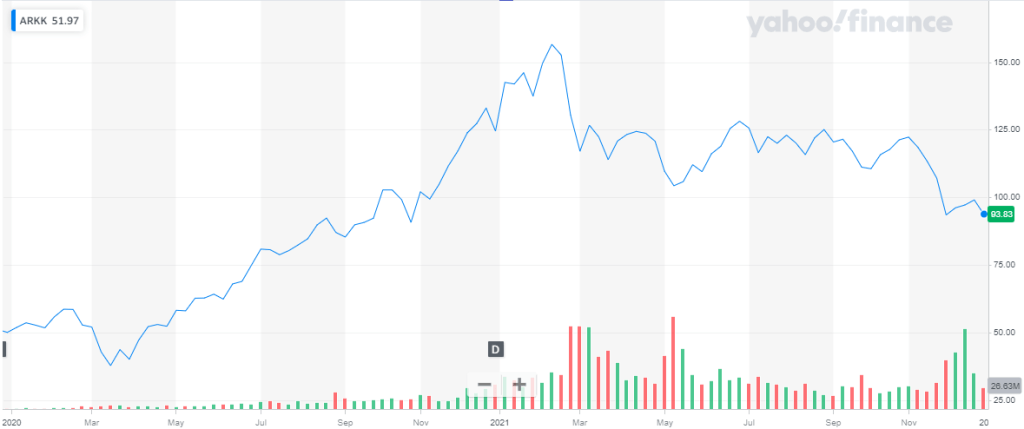
People tend to scream from the rooftops when they experience large returns but you don’t hear as much of a whisper when their portfolio is in freefall. Think back to 2020 and how much you heard about the Ark Invest’s Disruptive Innovation ETF (ARKK), which provided a massive annual return of 152%. The fund’s manager, Cathie Wood, seemed to have her finger on the pulse on everything that was happening such as the Work-From-Home and Electronic Vehicle trends. Now, fast forward to today and ARKK has whipsawed and has a 2021 year-to-date return of -25% (when the S&P500 has returned 27% in the same time period). We haven’t heard any of the usual market pundits say much about Cathie this year and the sad thing is that a lot of retail investors were too late when they invested in ARKK so they only experienced the 2021 negativity.

It may feel like the right move to change your investment strategy and jump on the most recent investment trends but if you’ve heard about it then it is probably too late. Changes to your investment strategy should only be made if something changes materially in your life.

We try to teach the younger generation about fads and how a fad usually falls out of favor as quickly as it came in so why would you gamble your life savings on one?

Want to discuss your Lifelong Financial Plan? Email me at info@financerx.ca

Forecasts & Fortune Tellers

With the end of the year fast approaching every analyst, research, and investment firm is rushing to get their 2022 Outlooks into the hands of advisors and investors. There will be predictions about everything including where interest rates and inflation are headed, what is going to happen in the stock and bond markets, and which countries around the world will flourish or flounder. These forecasts have the same accuracy as Miss Cleo’s psychic predictions that we all remember from TV programming in the 90’s or the famous Zoltar Fortune Teller machine from your local Spring Fair.

With more-and-more people around the world being connected by the internet everyday, the world changes quickly. The amount of information that gets exchanged per second is hard to wrap your head around, and it is only getting faster and faster, but this doesn’t stop economists and market strategists from issuing ‘precise’ forecasts for the year ahead. A few may be right but this is simply due to chance because of the vast number of firms that come out with these predictions. It’s like choosing lottery numbers, if enough people buy lottery tickets then someone will ‘predict’ what the numbers on the upcoming draw will be.

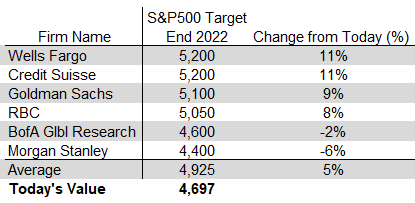
Reuters has compiled 6 of the major Wall Street firm’s predictions for the end of 2022 S&P500 target and they are as follows (from highest to lowest).

At the time of this writing, the S&P500 currently has a value of 4,696.56 meaning that the average prediction across these firms sees the S&P500 increasing by about 5%. The highest predictions are suggesting a 11% increase from today’s values and the lowest prediction is suggesting a negative 6% return. Will any of them be correct? Maybe, but no one can predict what will happen in the market tomorrow, let alone the value that it will have in over one year’s time.

I want to rewind a couple of years, which would have been December 2019, and I want to bring up some of the headline predictions for 2020:

RBC – New Year 2020 outlook : Boosting equity allocation as economy stabilizes, downside risks diminish

Wells Fargo – Recession risks in the rearview mirror, but a correction could be coming

BofA – 5 key trends will drive stocks next year

Goldman Sachs – 2020 election outcome a risk to equities

Credit Suisse – Cyclical leadership

Morgan Stanley – U.S. remains our least preferred region

Not a single firm suggested that a global pandemic would shut down the entire world. No one said that we would all be forced to shelter in our homes and hope that we did not succumb to a new type of corona virus. Not one headline about the S&P500’s shortest bear market in history (1.2 months), starting on February 20 and ending on April 7, and that we would experience some of the largest daily percentage losses in history (-12% on March 16 and -9.5% on March 12). Regardless of the bear market, the S&P500 still went on to achieve a positive return of 16% for the year. No one is holdings these firms accountable for missing this major world event because no one can expect anyone to predict something that is seemingly unpredictable, no matter their level of expertise on any subject. That being said, I still have friends and clients that ask me to pass along these predictions as I receive them, like it is something that they can use to make their own predictions for the upcoming year and turn them into better investors. I believe that these will actually leave you worse off as an investor because you’ll have some false confidence that you know what’s coming. The best thing you can do is realize and embrace the fact that the world is unpredictable, resulting in the markets being unpredictable in short periods of time.

The only solution that I have found to provide any sort of prediction of what the future holds is through long-term financial planning. Don’t try to forecast one year ahead because any funds that are required within one year shouldn’t be invested, unless you can afford the potential loss of needing the funds when the market is down. Forecast ten or twenty years and use long-term multi-decade averages for the assumptions within the plan. The average’s for the assumptions should encompass different periods of market & economic cycles. Creating the plan is step one, but the job is far from over. Planning is only valuable when it is revisited to quantify where you stand based on your goals. Are you still on track? Has anything changed in your life that requires a re-work of the plan? We know that the world is unpredictable and our lives are no different so make sure that you are focusing on the right tools to forecast your own personal success.

Want to chat about it? Email me at info@financerx.ca

Is Your Wallet Shrinking?

If you have watched or read the news lately then you will have heard about the “unprecedented” inflation as of late and I wanted to break this down a little. Inflation simply means the rate at which a dollar loses value over time. This is shown in the increase of the average price level of a basket of selected goods and services in an economy over some period of time.

StatsCanada released their Consumer Price Index (Inflation) report for October and, across Canada, CPI rose 4.7% on a year-over-year basis in October, up from 4.4% in September. This was the largest gain since February 2003. Energy prices were up 25.5% year over year in October, primary driven by an increase in gasoline prices. Passenger vehicles remained high compared with October 2020, increasing 6.1% year over year amid a global shortage of semiconductor chips. In addition, prices for passenger vehicles, accessories and supplies rose 3.6% year over year. Prices for meat products (+9.9%) continue to rise in October, as fresh or frozen beef (+14.0%) and process meat (+8.5%), which includes bacon (+20.2%), put upward pressure on prices. Labour shortages that have slowed down production, ongoing supply chain challenges and rising prices for livestock feed continue to factor into higher prices for meat. In British Columbia, this year we had the highest increase in property tax (+5.6%) compared to the other provinces. This increase in property tax was in part because of higher assessment values.

 To be able to assess whether this is high or low compared to other years, I wanted to look at the CPI in British Columbia over the last 5 years. What the data tells us is that inflation between 2019 to 2020 was almost zero (0.5%) and inflation from 2020 to 2021 was 3.8% so we are simply playing catching up to the 5 year average (2.4%). Gasoline saw the highest percentage change of 33% from 2020 to 2021 but it also saw the most percentage loss (-18%) from 2019 to 2020. Energy, which includes electricity, natural gas, fuel, etc., was the second highest percentage change of 21% from 2020 to 2021 but it also saw the second most percentage loss (-10%) from 2019 to 2020.

We can eliminate Gasoline and Energy from the equation and things seem to be pretty normal, spanning between 0.1% (Clothing and Footwear) to 5.8% (Goods in general).

Want to chat about it? Email me at info@financerx.ca

Investing & the Game of Pool

When it comes to discussing retirement with clients I always like to utilize real world examples. One example that came to mind recently is how investing in retirement is like a game of pool. When you are investing and are reliant on your investment income then the stakes are considerably higher than when you still have career income and are building your net worth.

When the stakes are high, you must ensure that you take time to be accurate and to line up your shots. You can’t just “shoot from the hip” and hope that you are successful. In investing, this means that you (or whomever is managing your assets) is doing their due diligence when picking your investments. You may get lucky once or twice but without a prudent investment strategy then you are playing Russian Roulette, especially when you have to invest through countless economic cycles and ensure that your funds last for multiple decades. You might not be able to recover if you have too much exposure to one company that ends up going out of business or one sector that falls out of favor for a long period of time so the key thing here is to ensure that you are diversified into various companies, sectors, and countries. Take your time to ensure that you are accurate and sure of every move.

During a high-stakes game of pool, it is easy to let our emotions get the best of us. When our emotions run high and we get frustrated then we have a heightened risk of making costly mistakes. We know that the best thing we can do for our game is to remain calm and patient but it’s easier said than done, and it is exactly the same for investing. We can experience market-wide losses and people are ready to sell everything and go to cash rather than staying calm and patiently waiting for the market to recover. Generally speaking, if the money is needed in the short-term then you shouldn’t be investing that portion anyway. Be patient and don’t throw in the towel early, there is still lots of game to be played. 

In investing and pool, we tend to have a short-term memory. You may have played well up to now but that doesn’t mean that your streak will continue. If the market has gone through a period of time with lower than average negative volatility then we tend to think that it will continue into the future and we are surprised when it doesn’t (see my article, “It’s Not a Matter of If, It’s When…”). If the market goes through a period of time that we see substantial negative returns then we still seem to think that it is going to continue rather than recover, even when a recovery is actually more probable. During short periods of time, we may find ourselves on hot streaks and on cold streaks but in the long term we are no better or worse than our asset allocation and, over time, our skill at pool and investing will always regress back towards our own average.

The winner will always be the one that has avoided making the most mistakes. Take your time lining up your shots, don’t let your emotions get the better of you, and ensure that you don’t let your past experiences cloud your future judgement. If you have a financial plan and remember these tips then you should have no problem “running the table.”

Want to chat about it? Email me at info@financerx.ca

The Bank of Mom & Dad : Open For Business?

Housing affordability in Canada is always a debated topic. On one side of the argument you have the older generation, who are already home owners. This population has been able to add to their wealth simply by owning the home in which they have lived for decades. On the other side of the argument you have the younger generation, who are trying to achieve home ownership in one of the most expensive housing markets in the world. It can seem like an absolutely daunting experience to start to save for a down payment while you are paying rent and your other bills.

I thought that the best way to present this data in the form of a line graph. I sifted through as many databases on the internet as I could in regards to historical figures. There is some variance in the numbers across multiple databases but the trend remains the same across the board; total before-tax household income is nowhere near keeping pace with the incredible pace of growth in Canadian real estate.

A lot of media attention has been given to “The Bank of Mom & Dad” lately and the fact that “roughly 30 per cent of first-time homebuyers and nearly 9 percent of existing homeowners received financial help from family this past year to purchase a home.” “First-time buyers received an average gift of $82,000, while “mover-uppers” were gifted a whopping average of $128,000 in September 2021.” Families are looking to give their children a helping hand to start their life and it can be a huge help, like starting a marathon by being shot out of a cannon rather than the traditional method of jogging with the pack. It can be a huge help but that help doesn’t come without risks. There are several ways that all or a portion of those funds can vanish so I believe that knowing and understanding the risks before hand will help determine whether you are willing to take that risk.

Risk 1: Are you sure that you will have enough for the rest of your life? This is probably the greatest risk of anyone in retirement today and I’ve talked about this in my past article (The Invisible Thief). People are living longer than ever and inflation will be the largest drag on their portfolio over the rest of their lifetime. More and more pensions are becoming non-indexed or are based on employee contributions (like defined contribution pension plans) so it will be up to you to ensure that your income accounts for inflation. With the average Canadian family earning around $100,000 gross per year, Canada’s long-term average inflation rate of 3.52%, and the average length of retirement of around 20 years, you better be prepared to double your income over those 20 years to maintain your purchasing power.

Risk 2: Once the gift has left your bank account and is provided to your child then it becomes their property. This means that your funds won’t be protected if your child (or their spouse) should have any issues with creditors or they experience a marital breakdown. One option to minimize the proportion of funds that the creditors or an angry spouse can get is to co-sign on the mortgage but it still may result in the home being sold if there isn’t enough funds to satisfy the court order. Co-signing on the mortgage can also result in the property losing a portion of its principal residence designation for your child, which is one the greatest gifts of home ownership in Canada, so this may not be the best option.

Risk 3: Fairness remains a big thing when it comes to parents treating children equally. If you have decided to help one child now then you can add a clause in your will that will consider any gifts provided during your lifetime as part of their portion of your estate upon your passing. This is known as a hotchpot clause.

Rather than an outright gift, how about using a promissory note? A promissory note is an enforceable promise to pay back a loan or debt. The note will have a repayment schedule, provisions for interest and the applicable rate, consequences for missed payments, and parents may even wish to register their interest on the title of the child’s home. All parties involved will need to sign the note and it should be witnessed and/or notarized. This ensures that your interest in the property remains your interest with legal documentation to support that. If your intention is to eventually forgive the note in the future then this is something that can be addressed in your will. You should always seek legal counsel before any money changes hands and ensure that you understand the risks involved or if any changes need to be made to your estate documents.

Want to chat about it? Email me at info@financerx.ca

It’s Not a Matter of If, It’s When…

We are getting closer to the end of 2021 and the S&P500 index has put on an impressive year-to-date run of about 25%. November 18 marked the 66th record close for the S&P500 in 2021, with a closing value of 4,704.54, and the year isn’t over yet. The only other year in history that has a greater number of record closing highs is 1995, which had 77. My observation about years, such as this year, that result in lower than average negative volatility is that people suffer from amnesia about normal, and completely healthy, periods of market decline.

The monthly decline for the S&P500 in September 2021 was -4.65% and I can’t tell you how many clients had immediate anxiety that the value on their September statement had a lower value than their August statement. My answer to every client was the same, “has something materially change in your life? If nothing has changed then there is no reason to panic or change your investments. The market pulls back, on average, 14.3% every year at some point during the year so September’s decline was actually only a third of the average decline that we experience every year. If the decline continues into a bear market then our bear market income strategy is already in place and ready so your income will remain unchanged and uninterrupted.”

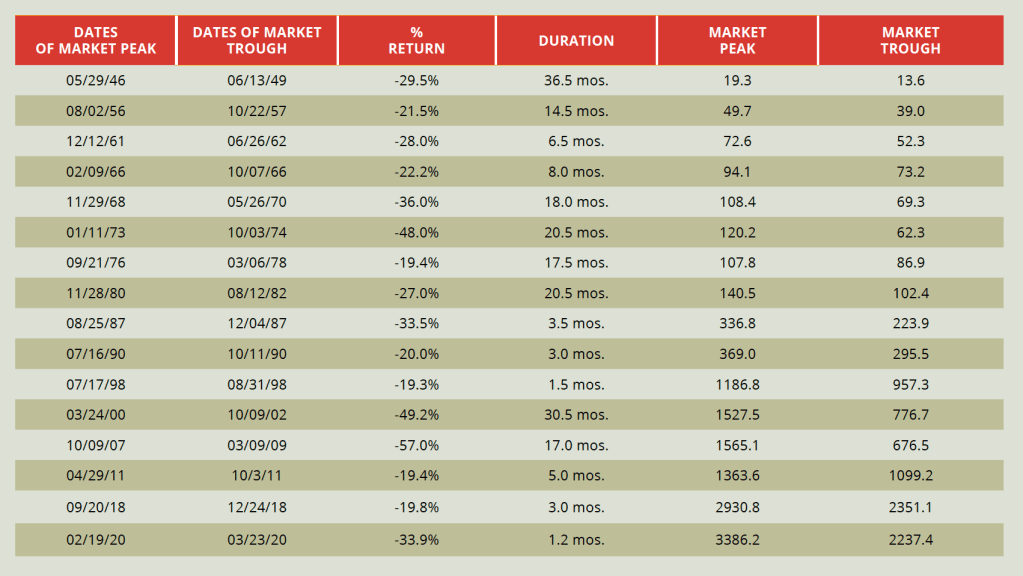
These calls prompted me to provide a bit of a history lesson; 75 Years of Bear Markets. Taking the direct definition from Investopedia, “a bear market is when a market experiences prolonged price declines. It typically describes a condition in which securities prices fall 20% or more from recent highs.” Over the course of the last 75 years we have experienced 16 bear markets and all of them have had a variety of lengths and temporary declines. This works out to an average occurrence of a bear market about every 5 years. The average bear market decline is -30% but there have been numerous times where the decline has only touched the official -20% mark mid-day but it also has been as traumatizing as -50% (2000). The average duration from the market peak to the beginning of the recovery has been around 13 months but it has been as short as 1 month or as long as 3 years. I’m going to say this again so that it can sink in, the average decline experienced in a bear market is -30% and it happens, on average, once every 5 years. If you aren’t absolutely confident that you won’t make an emotional decision and sell at a loss once you see your portfolio temporarily lose 1/3 of it’s value then investing in equities might not be for you. If you make the wrong decision and sell at the wrong time then it may be a mistake that you will never recover from. Bear markets are impossible to predict but they are something that you can plan for. Having a knowledgeable advisor in your corner, who has seen these types of markets before, can also be a big help to get you through the emotional experience that comes with a bear market.

If you are reliant on the reoccurring income from your investment portfolio then one option is to keep enough liquid cash reserves (or cash equivalents) on hand to get you through the worst of the decline so that you can shut off the income from your investment portfolio and allow it to recover. Another option for investors that do not want to keep a lot of cash on hand (especially in our current low interest rate environment) is to have access to a low interest rate line of credit, which can be utilized to replace the regular income from your portfolio. In terms of taking advantage of lower prices, you might not have any extra money to add to your portfolio but you can switch your portfolio’s dividends to reinvestment so that you are still purchasing additional shares of great companies at depressed prices.

If you are still accumulating assets then any bear market is a buying opportunity and you should never let the opportunity pass you by, even though your emotions may be screaming otherwise. Shelby Cullom Davis, who was an American businessman, investor and philanthropist, stated it perfectly when he said, “you make most of your money in a bear market, you just don’t realize it at the time.” The fact is that you will probably never see these “on-sale” prices again for the great companies that make up the market so do not let the buying opportunity pass you by. Look back at the chart I provided and look at some of the values of the S&P500 in the “Market Trough” column and now compare that to the closing value of 4,704.54 on November 18, 2021. Looking at the most recent bear market, which was a result of CoVid, if you would have taken advantage of that buying opportunity then you have experienced a gain of over 100% in about a year and a half.

No one can tell you when the next bear market will be, what will cause it, or how long it will take to recover but I can tell you with 100% certainty that there will be another one at some point in the future, we will get through it, and the market will achieve additional record highs after it is over.

If you need help preparing your own personal bear market income strategy then reach out to info@financerx.ca.

Don’t Be An Ostrich

It’s actually a fallacy that ostrich’s bury their head in the ground but have you ever had a problem in your life that you try to avoid at all costs so you just choose to ignore it? We all do it and we all know that it usually makes the problem worse and we still make that choice rather than face our problems head on. The problem that I am specifically talking about today is goal-planning. Everyone’s goals are different but the requirement of having specific, measurable, and attainable goals should be the same for everyone.

Here are some examples that I hear regularly, “I want to be able to help my children with their education,” or “I want to be comfortable in retirement.” These are not goals, they are statements.

Let’s start with the statement, “I want to be able to help my children with their education.” This statement just opens the door to many other questions. Do you want to utilize an Registered Education Savings Plan or a form of low-interest debt? Both? Do you know how to take full advantage of the government bonds and grants? Do you expect your child to pay a portion of their expenses? Do you expect them to get their education in the same city as you live or what if they decide to move somewhere else in Canada (or do a year abroad)? What programs do you think they will be interested in? These are just some questions to get you thinking. There is a vast discrepancy in the cost of different forms of education that are available and you don’t need a degree in math to budget for their education but it definitely helps if you ask someone knowledgeable in that area for help. Remember in the beginning of the article when I talked about goals being specific, measurable, and attainable? Here is an example of a goal regarding education, “I want to ensure that I can provide my child (who is 5 years old today) with at least $10,000 per year for 4 years to help with their education after they graduate primary school.” This goal is specific because it says how much, when it is to be paid and for a specific duration of time. This goal is measurable as the progress can be tracked over time. This goal is attainable due to the fact that it doesn’t require an unrealistic outflow to achieve this goal. In this example, the child is 5 years old and the goal is achievable by their 17th birthday by investing around $200 per month into a moderate investment from the age of 5 in a RESP until the end of the year in which the child turns 13.

Now on to setting a goal for retirement, but we will start with one of the statements that I usually hear, “I want to be comfortable in retirement.” This does not give any insight into what you are trying to accomplish. Are you talking about creating a multi-decade inflation-adjusted income that will last for the rest of your life or are you talking about the La-Z-Boy chair that you plan on purchasing for your living room? How about something along the lines of this, “I would like to be able to achieve an after-tax, inflation-adjusted income of $5,000 per month (in today’s dollars) starting from age 65 and last me until age 100. I am open to downsizing to a condo upon retirement so that I can travel stress-free and help fund my retirement expenses. I want to ensure that I have enough money saved so that I have the choice of hiring in-home care after the age of 80 and I want to leave a $500,000 legacy for my children.” This statement is very specific, can be measured as time goes on, and is attainable. You may currently be in retirement, be close to it, or it may be a distant hope but everyone should, at the very least, be thinking about it. There is no “too-late” when it comes to retirement but the more time that you have before that day then the more options that you have to achieve your goals.

The chance of your life happening exactly as planned is next to zero and these are just some pointers as to how to create a real goal. The true value in setting goals and the creation of a plan to achieve those goals is through revisiting and revising both as time goes on. Our lives are dynamic and ever-changing and so-should your goals and plan to achieve those goals.

Our lives equate to the sum of every decision that we make along the way and you have all the power to guide your own personal results. Don’t be an ostrich and let time and the rest of the world pass you by while you have your head in the sand.  

If you need help creating a vision for your own personal multi-decade journey then feel free to reach out to info@financerx.ca.

Fall Back to your Budget

This past Sunday marked the end of Daylight Savings Time (DST) so everyone’s clock reverted by one hour and you got an extra hour of sleep. It’s funny that we are even still participating in this semi-annual chaos on our internal body clock. The whole reason that DST was created was during World War I to try to save energy. Just like income tax, it’s an artifact of global war.

During the fall months, instead of waking up and using electricity before sunrise, you are technically sleeping in for an additional hour and are able to wake up closer to sunrise. But now it is technically an hour later when you get off work, meaning that you are contending with the darkness for your commute home and your free time after work, so you are probably using more electricity overall. DST’s fall-back results in a decreased overall exposure to sunlight during the normal hours of free time, which only amplifies the effect of Seasonal Affective Disorder (SAD).

SAD is a direct result of less exposure to sunlight, which negatively effects our mood and can lead to feelings of drowsiness and depression. A 2017 study found that hospital visits for depression increased by 11% around the time of transition from DST to standard time. The study finds evidence that the distress associated with the sudden advancement of the sunset, marking the coming of a long period of short days, to explain the up-tick in hospital depression visits.

This leads us to preparing for the coming of shortened days and the eventual increased expenses at Christmas time. Unfortunately, we can’t make the days any longer but we can help some of the pain that comes along with Christmas over-spending through money management over the course of the next six and a half weeks. Is there anything that you can cut out of your normal spending routine for the time being? Review your regular subscriptions like cable packages, streaming services, unused gym memberships, or expensive meal kits. Can you forgo going out to eat and drink with friends and have them at your house instead? If there is something expensive that you want to purchase then you can utilize a “cooling off period” for a couple of days to see if you actually need that product or service.

We know that the next few months are going to be filled with more hours of darkness but you don’t have to magnify the effects of SAD with guilt and anxiety from having to play catch up in 2022 to pay for Christmas overspending too. Every dollar counts and you’ll thank yourself for whatever the amount that you can save over the coming weeks.

Want to chat about it? Email me at info@financerx.ca

It’s Beginning to Look a Lot Like …. End of Year Planning

Well, it is officially November, which means that the weather is changing and you are probably thinking about travelling to a beach somewhere. November also means that you should start to think about things that need to be completed before the year is over or early next year.

Several deadlines that come to mind for the end of December include Tax Loss Selling, Charitable Donations, and Conversions from an RRSP into a RRIF for anyone born in 1950.

Tax Loss Selling is the opportunity to sell any investments in a Non-Registered account that are currently at a loss. These losses can be used to offset any taxable capital gains in any of the three preceding years, the current year, or they can be carried forward indefinitely. The settlement of selling the investment must take place before December 31 so, if the stock is publicly traded then, you must place the sale order no later than December 29. There are special rules called “Superficial Loss” rules for buying the investments back so an easy rule to follow is to wait 30 days before buying the security back to avoid the risk of the capital loss being denied by CRA.

Charitable Donations allow you to receive federal and provincial tax credits that can result in large tax savings. The first $200 that is donated is given a small tax credit and then the remaining amount of the donation is given a higher tax credit. In B.C., if you were to donate $1,000 in 2021 then you can potentially get a combined federal and provincial tax credit of $406. The last day to receive credit for 2021 donations is December 31 but donations can also be carried forward for up to 5 years.

If you were born in 1950 then you must convert all registered investment accounts. This means that all of your Registered Retirement Savings Plans (RRSPs) and Locked-In Retirement Accounts (LIRAs) must be converted into Registered Retirement Income Funds & Life Income Funds, respectively. At a minimum, you will be required to take 5.28% of the value of these accounts on December 31 as income in 2022. For example, if your RRSP was converted into a RRIF and it had a value of $100,000 on December 31, 2021 then at some point in 2022 you would be required to withdraw $5,280. This income is 100% taxable in the year that it is received. **If you have already turned 71 this year (or will be turning 71 before December 31) then you are still eligible to contribute to your RRSP for the 2021 tax year but you must complete the contribution prior to year end.

New Year, Same Reminders

January 1 marks a new tax year but it should also mark some of the usual reminders for you too. A new year means another annual top up for Tax Free Savings Accounts, Registered Education Savings Plans, and Registered Disability Savings Plans.

The Government has not officially come out with their Tax Free Savings Account contribution limit for 2021 but it shouldn’t be too long before they make their announcement. If you were over the age of 18 in 2009 then you have accrued a total TFSA contribution limit of $75,500 up to the year 2021, which was an additional $6,000. If CRA announces that 2022 will have a contribution amount of $6,000 then it will bring the total allowable accrued TFSA contribution limit to $81,500 but there is a potential that they may increase the 2022 contribution limit to $6,500 due to the annual inflation adjustment that they factor in. Tax Free Savings Accounts are one of CRA’s greatest gifts to Canadians as it allows you to invest and shield all capital gains from tax but, in terms of estate planning, it also allows you to pass money to your heirs without being subject to probate or tax.

Registered Education Savings Plans have an annual limit of $2,500 that you can contribute per beneficiary. This would result in an automatic Canadian Education Savings Grant of $500. There is the potential of making up for previous years that may have been missed and I have included a link to my RESP article that goes into this in greater detail.

Registered Disability Savings Plans are a fantastic way to help a Canadian family member that has disabilities save for their future. This type of account allows the beneficiary to defer all accrued tax until a withdrawal is made. The Canadian Government also has grants and bonds that can be utilized. Under the Canada Disability Savings Grant, depending on the beneficiary’s adjusted family net income and the amount contributed, the Government will match contributions by 100% – 300% of the amount contributed, up to a maximum of $3,500 in one year and up to $70,000 over the beneficiary’s lifetime. The Canada Disability Savings Bond is meant to assist low-income Canadians with disabilities and will pay a bond up to $1,000 a year, up to a lifetime bond limit of $20,000. No contributions are required for the CDSB.

Want to chat about it? Email me at info@financerx.ca
The Invisible Thief

We’re all living longer and we can thank technology, medical, and public health advancements but are you ready for it?

In Canada, in 1950, the average life expectancy from birth was 68 years and by the year 2000 the average life expectancy had increased to 79 years old. The U.N. projects that by 2050 the average Canadian will live to be 86 years old. If the projections hold true then life expectancies over the course of the century will have increased by 18 years, or almost two decades! This is something that we should all be very happy about as it means that we have more time to grow our minds, families, and our legacies but this increase in life expectancy can also be a curse if you aren’t prepared for it.

You’ve probably heard your grandparents or parents say, “in my day, a chocolate bar cost a dime,” or something else along these lines. Inflation is known as “the invisible thief” because you can’t see it, and (most of the time) you probably won’t notice it in your day-to-day lives, but it’s always there and is defined as the general rise in the prices of goods and services in an economy. Simply put, the amount of things that you can buy with $20 today will be less than what you can buy with $20 in years to come. Using 1950 as our baseline, Canadian inflation has averaged at a rate of 3.52% per year. By applying the average, we see that you need $10.95 in 2021 to purchase the same amount of goods that $1 would have purchase in 1950.

In Canada the average person retires at the age of 64, which means that they will need to have an adequate nest egg to live on for approximately 20 years. Bear in mind that I am using the average and 50% of people will need to have enough of a nest egg to last even longer than two decades. We are fortunate to have Government Pensions in Canada but they are only meant to replace some of the income that you lose once you make the decision to retire. In 2021, the average Canadian earns $14,858 total from CPP & OAS, which works out to $1,238 per month. Think about your day-to-day life and imagine how difficult it would be to live on that amount. Luckily for us, the CPP & OAS are indexed to inflation so “the invisible thief” doesn’t get a piece of this over time.

Let’s look at the math… the average income for a full-time worker in Canada is around $55,000 gross per year and we know that the average Canadian will have to fund a retirement of around 20 years. Using the historic average Canadian inflation rate of 3.52% then we see that someone starting their retirement today with an income of $55,000 per year will need an income of $109,862 per year after 20 years of retirement to buy the same amount of goods and services.

The only way to outrun “the invisible thief” is to ensure that you are earning at least 3.5% annually on the money that you are saving for your future. Today, achieving an interest rate even close to 3.5% per year in a savings account, GIC, or government bond is impossible so, unless the funds are earmarked for something specific in the short-term, the only way to ensure that you aren’t effectively losing money over time is to invest. I’m not talking about investing in the newest “hot stock” that your neighbor, colleague, friend, or financial television network pitches you. As well, I’m not saying that you won’t potentially get lucky by taking stock tips from people in your life but this is akin to gambling and I can’t provide advice on where the ball will land in a game of roulette either. I’m talking about a globally diversified investment solution that invests in corporations with a reputation for quality, reliability, and the ability to operate profitably in good and bad times.

A diversified investment solution is a means of achieving your goals but a financial plan is the map of how you get there. No plane takes off without a flight plan and no ship sets sail without a plotted course. No flight plan or plotted course is followed exactly either and there will be numerous challenges and course corrections that will need to be addressed during the journey. This is why it is so important to have a plan but it is even more important to update the plan (at least annually or whenever a material change occurs in your life). You shouldn’t embark on a multi-decade retirement journey without a plan as to how you are going to get there, what sort of obstacles that you may encounter along the way (possibly downsizing, dealing with health challenges, sickness & survivor planning) and what sort of legacy you want to leave behind to your heirs (estate planning with a focus on tax efficiency).

If you need help creating a vision for your own personal multi-decade journey then feel free to email info@financerx.ca.