Exploring Alternatives to Income Tax : Paths to a More Modern, Balanced, and Equitable Tax System in Canada

Income Tax has become a staple of modern society, with the proceeds helping to fund essential services and infrastructure. Its roots stretch back centuries but, in Canada’s case, it was only implemented in 1917 as a temporary wartime initiative.

Before the introduction of income tax, the bulk of Canada’s revenue came from taxes on imported goods, sales taxes, and excise duties. When Canada entered World War I in 1914, this prior method proved insufficient to cover the mounting costs of wartime operations. As the war dragged on, the government needed a more reliable and substantial revenue source to sustain its military commitments and address domestic economic strains. It was intended as a temporary solution to generate revenue, based on an individual’s income level, during the war.

The Income War Tax Act marked the birth of Canada’s federal income tax and was introduced by then-Finance Minister Sir Thomas White in 1917. The initial rates started at 4% on taxable income above $2,000 for individuals and peaking at 25% for high earners. In 2024 dollars, this would mean that income tax starts for individuals with a taxable income above $53,700. The government assured Canadians that this tax was a temporary emergency measure, promising its repeal once the war’s financial demands were met.

Despite the end of World War I in 1918, the income tax system persisted. Canada was left with massive war debts and growing peacetime expenditures, which resulted in income tax becoming a permanent fixture by 1920 as the primary tool for funding federal government programs and services.

The outbreak of World War II in 1939 led to another major expansion of the income tax system in Canada. As in World War I, the government needed vast amounts of revenue to support the war effort. During this period, the tax base widened significantly, with more Canadians become subject to income tax. By 1948, income tax rates were much higher, and many more individuals were required to file returns, making it a truly national tax system.

After World War II, income tax become essential for financing Canada’s growing welfare state. The government used income tax revenues to fund key social programs, such as healthcare, education, unemployment insurance, and infrastructure. The progressive nature of income tax – where higher earners pay a larger share – allowed it to support these broad social initiatives while also reducing economic inequality.

By the 1970s and 1980s, Canada’s tax system had evolved to include a more structured rate system, numerous tax deductions, credits, and exemptions. The Canada Revenue Agency (CRA) established as a formal entity, played a crucial role in standardizing and managing tax collection across the country.

Income tax remains the cornerstone of Canadian public finance, accounting for a significant portion of the federal government’s revenue. It helps fund a wide range of public services, including healthcare, education, defence, infrastructure, and social welfare programs like the Canadian Pension Plan and Employment Insurance.

The tax system has seen numerous reforms over the past few decades, with efforts aimed at simplifying the process, reducing tax evasion, and making the tax system more equitable. Notable changes include the introduction of the Goods and Services Tax (GST) in 1991, new tax credits like the Canadian Child Benefit, and measures aimed at supporting low-and middle-income families. Recent debates focus on the balance between tax rates, fairness, and competitiveness, especially with neighboring countries like the U.S..

Several potential alternatives to income tax exist, each with unique benefits and drawbacks. Here are some of the main alternatives that countries have considered or implemented to varying extents:

Consumption Tax (Sales Tax or Value-Added Tax [VAT])

    How It Works : Consumption taxes are levied on goods and services at the point of sale. The VAT, a common form, is applied at each stage of productions and distribution, with the tax ultimately being passed on to the consumer.

    Pros : Encourages savings and investments, as only spending is taxed. It’s relatively straightforward to implement and can be a stable revenue source.

    Cons : It tends to be regressive, as lower-income individuals spend a larger proportion of their income on consumption, potentially increasing inequality without exemptions or rebates for essential items.

    Flat Tax

    How It Works : A flat tax system applies the same tax rate to all taxpayers, regardless of income level. This could either be applied to income, consumption, or both.

    Pros : Simple to administer, transparent, and can increase tax compliance due to its straightforward structure. It reduces complexity, potentially lowering government administrative costs.

    Cons : Flat taxes are often seen as less fair, as they don’t account for individuals’ varying abilities to pay. Without additional policies, it could disproportionally impact lower-income earners.

    Land Value Tax

    How It Works : A land value tax is levied on the value of land itself, excluding buildings or other improvements. This idea, promoted by economist Henry George, aims to tax the unearned value increases that arise from location, infrastructure, and community development.

    Pros : Encourages efficient land use and discourages land speculation. It’s seen as a fairer way to tax wealth, as land value often reflects public investments and community desirability rather than individual productivity.

    Cons : Landowners might resist, as it can reduce the profitability of holding unused land. It also required regular and accurate land valuations, which can be administratively complex.

    Wealth Tax

    How It Works : A wealth tax is levied on individuals’ total net worth, including assets like property, stocks, and other investments. It taxes wealth accumulation rather than income.

    Pros : Helps address wealth inequality and can generate significant revenue from the wealthiest of individuals. It can reduce the need to tax income, potentially encourage economic growth.

    Cons : Difficult to administer due to valuation challenges, especially for assets like private businesses and non-liquid holdings. Some argue it discourages wealth accumulation, potentially impacting investments.

    Carbon Tax or Environmental Taxes

    How It Works : Carbon taxes and other environmental taxes are levied on activities or products that harm the environment, such as carbon emissions, plastic usage, or resource depletion.

    Pros : Encourages environmentally friendly behavior, supports sustainability goals, and can generate revenue that could offset the need for income tax.

    Cons : Revenue from environmental taxes can be volatile, depending on consumption patters and regulatory changes. These taxes also don’t provide a broad base unless coupled with other forms of taxation.

    Financial Transaction Tax (FTT)

    How It Works : An FTT is applied to transactions in financial markets, such as stock, bond, and derivatives trades.

    Pros : Raises revenue from the financial sector, which often has high transaction volumes. It may discourage excessive speculative trading, potentially stabilizing financial markets.

    Cons : Could reduce liquidity in financial markets and impact investment behavior. The tax base can be narrow, required high rates to generate substantial revenue.

    Inheritance or Estate Tax

    How It Works : Inheritance or estate taxes are levied on the transfer of wealth upon death, taxing large inheritances or estates over a certain threshold.

    Pros : Helps address intergenerational wealth inequality, preventing the concentration of wealth across generations. The tax impacts only those receives large inheritances, potentially reducing the need for taxing income.

    Cons : Inheritance taxes can be unpopular and administratively complex. They can encourage tax avoidance strategies and may impact family-owned businesses and farms unless structured with exemptions.

    User Fees and Charges

    How It Works : Governments impose fees for the direct use of certain services, such as road tolls, water usage fees, or national park entry fees. These taxes are targeted, with users paying for the services they consume.

    Pros : Fairly straightforward and aligns costs with usage. It can relieve the burden on general tax revenue and focus taxes on specific areas of need.

    Cons : Limited revenue potential, as fees are only applicable to specific services. It can be regressive and may discourage people from using essential public services if fees are high.

    Payroll Tax

    How It Works : Payroll taxes are levied on wages and salaries, often split between employers and employees, and typically go toward specific funds like OAS or health care.

    Pros : Payroll taxes are stable and predictable. They can fund specific social programs, aligning costs with the benefits people receive.

    Cons : It still impacts workers’ income and can reduce employment opportunities if employers bear significant costs. It also doesn’t address other forms of wealth or income, like capital gains.

    Universal Basic Income with a Negative Income Tax

      How It Works : This approach involves providing all citizens with a basic income or cash transfer, with taxes applied on higher earners to recapture some of these payments. A negative income tax specifically supports low earners, essentially giving cash payments to those below a certain income level.

      Pros : Promotes income equality and reduces poverty, with targeted support for low-income individuals. Simplifies the tax system by replacing various benefits with a single, unconditional payment.

      Cons : Requires significant funding, which likely require other taxes or reallocation of funds. Implementation and determining fair levels of payment can be challenging.

      Tariffs and Import Taxes

        How It Works : Tariffs and import taxes are fees imposed on imported goods, either as a percentage of their value or as a fixed rate. They’re used to raise government revenue and protect domestic industries by making imported goods more expensive.  

        Pros : Tariffs can bring in significant revenue, particularly in economies with high import volumes. By raising the cost of foreign goods, tariffs support domestic industries, preserving jobs and bolstering local production. These types of taxes are easier to manage compared to complex income tax systems.  

        Cons : Increased import costs are often passed to consumers, disproportionately affecting lower-income households. Heavy tariff reliance can provoke trade wars, impacting exports and the broader economy. Tariffs alone can’t typically fund all government operations, especially in economies reliance on diverse imports. Modern industries relying on imported materials may face higher costs, reducing competitiveness.

        While income tax has been essential for funding Canada’s public services and social programs, exploring alternatives offers the potential to reduce reliance on it. All of the alternatives discussed each provide unique benefits, and a thoughtful combination could lessen the overall income tax burden. By diversifying the tax base with these alternatives, Canada could maintain necessary revenue while promoting economic fairness and resilience. A balanced approach may allow the country to adapt to modern financial needs, potentially easing income tax rates and creating a more flexible, equitable tax system.

        Email me at info@financerx.ca.

        Turning Dreams into Reality

        From buying a vacation home to retiring abroad, your dreams start with the creation of a solid plan. A well-crafted financial plan not only sets clear goals but also creates actionable savings, investment, and tax strategies to help you reach them. As life evolves and new milestones are reached, your goals may change, which is why your plan must be flexible and adaptable.

        Here are six key elements every effective financial plan should include:

        Cash flow planning for short-term goals

        Life is full of surprises—whether it’s an unexpected expense or a sudden opportunity. That’s why maintaining liquidity is crucial to cover ongoing needs and respond to short-term demands. A robust cash flow strategy ensures you’re ready for whatever comes your way without compromising your longer-term objectives.

        Investment strategies for medium and long-term goals

        A well-thought-out investment strategy is essential to keep your long-term goals on track without leaving funds idle. Whether you’re planning to buy a second property, explore new business ventures, or create lasting family memories through travel, your investments should align with your time horizon and risk tolerance, tailored to each of your objectives.

        Retirement planning

        Retirement planning isn’t just about saving—it’s about creating a sustainable income for your future. We’ll work together to optimize your contributions, design personalized investment strategies, and ensure your savings are effectively transformed into income when you’re ready to retire. Pre- and post-retirement planning are key to building a comfortable and secure future.

        Business succession planning

        What’s the future of your business when you’re ready to step back? Whether you envision staying involved, selling your stake, or passing it on to the next generation, succession planning is crucial. We’ll address potential inflows or outflows to ensure your business transition aligns with your personal financial goals.

        Wealth transfer to the next generation

        Wealth transfer doesn’t have to wait until the end of life. Whether through gifts, trusts, or other strategies, transferring wealth during your lifetime can be a powerful tool for supporting your family and managing taxes. We’ll explore the best options to align your wealth transfer plans with your overall financial strategy.

        Legacy and estate planning

        Legacy and estate planning are about preserving your values and ensuring your wishes are honored. From structuring wealth transfers to your loved ones to supporting your favorite charities, we’ll develop a comprehensive strategy that includes estate protection and insurance needs, tailored to your unique goals.

        Partnering for success

        A comprehensive financial plan is your roadmap to achieving your personal goals. Together, we’ll create tailored strategies to adapt to your evolving priorities, ensuring your wealth planning remains proactive and intentional. I can help you design customized investment, tax, and savings solutions that align with your vision.

        Email me at info@financerx.ca.

        The Hidden Pitfalls of Estate Planning & Things to Keep in Mind If You are Named as an Executor

        Surprisingly, a 2022 report from the National Institute on Aging revealed that only 48% of Canadians have a will. So, in other words, more than half of all Canadians would prefer to have the government allocate their financial assets and heirlooms to their heirs.

        When it comes to estate planning, one of the most crucial decisions you’ll make is selecting the right executor and trustee. If you have a will, you’ll need to name an executor. If you have trusts, you’ll need a trustee. Many affluent individuals have both, and even multiple trusts, each serving a unique purpose. If conflicts within your family are likely, it would be wise to consider appointing a third party as your executor or trustee. While corporate trustees like lawyers or bank trust departments charge fees, even a family member acting as an executor can legally take up to 5% of the estate’s value as compensation.

        The first and most essential step in estate planning is simple: don’t leave your family in the lurch by dying without a will. If you die intestate, your assets are distributed according to a standard template set by the provincial legislature, which may not align with your wishes. Signing a will and any relevant trust documents ensures that your assets—both financial and sentimental—go to the people and causes you care about.

        For those with complex family dynamics or specific concerns about how their heirs will handle a windfall, trusts offer a way to manage the distribution of assets. Whether you’re worried about a beneficiary’s spending habits, vulnerability to scams, or even a rocky marriage, trusts allow you to control how and when your assets are accessed. You can set conditions for the distribution, such as age milestones, health care needs, education expenses, or housing purchases. This foresight allows you to protect your loved ones long after you’re gone.

        If you find yourself on the other side, as the executor or trustee of an estate, your first rule should be: take your time. While notifying pensions, financial institutions, insurance companies, and canceling subscriptions is a priority, distributing assets to heirs should be anything but rushed. The probate process can take up to a year, allowing time for creditors or any potential disputes to surface. Acting too quickly could result in personal liability, as you could be held accountable if other claims emerge after distributions are made.

        Serving as an executor or trustee comes with significant responsibilities and potential risks. Consider hiring an estate lawyer or a trust company to navigate the probate process and minimize your liability. It’s also wise to discuss these matters with your loved ones while they are still here, ensuring that everyone is clear on the details and intentions of the will or trust.

        Finally, remember that as an executor or trustee, you’re entitled to compensation for your time and effort. If you’re considering taking on this role, make sure you fully understand the responsibilities and the potential pitfalls involved. Estate planning isn’t just about passing on wealth; it’s about ensuring your legacy is managed according to your wishes and protecting those you care about from unnecessary stress and conflict.

        Email me at info@financerx.ca.

        Don’t Believe the [Negative] Hype

        As humans, we have ancient mental traits that helped us survive a millennia ago but now these same traits often just get in the way. Imagine yourself living in a cave, as one of your ancient ancestors, and you’re preparing to go on a hunt but something seems off. You are hearing noises outside that deter you from wanting to leave the comfort of your “home.” You have two choices: Leave the safety of your cave and risk death; or skip the hunt, go hungry, and wait for the potential danger to pass. The majority of people would rather stay home to live another day.

        The next day, the cognitive rollercoaster isn’t over yet as, most people would have an increased sense of nervousness when they attempt to leave the cave. But now there will also be another negative thought that combats the nervousness, they will have an added fear of failure that will start to seep into their mind. When that fear of failure overtakes the fear of the outside then they will leave the comfort of their home and venture into the unknown, albeit on edge and with heightened senses.

        Humans have evolved over hundreds of millions of years to pay extra attention to negative experiences (especially life and death situations) by reacting to them intensely, remembering them well, and over time becoming even more sensitive to them.

        What does this have to do with you, today? We can think of a similar situation albeit more modern. Imagine you’re driving on the highway and someone cuts you off and narrowly misses you. You slam on your brakes and feel a tense feeling of anger rise up within you. This sort of feeling is one that can stay with you and can eventually ruin your whole day. You might be less productive or distracted, which only compounds the problem. This experience might stay with you for awhile and effect your driving habits for a period of time after the actual event.

        Why does one negative experience ruin an otherwise great day?

        Why does this experience have such a powerful effect on us?

        Why is it that this experience of short-term unhappiness is invested into long-term unhappiness?

        Research has proven that our brains have evolved to react much more strongly to negative experiences than positive ones. This negativity bias can influence how we feel, think, and act, and can have some undesirable effects on our psychological state.

        We can think about this in the context of investing and investment news. A downturn in the markets creates the same fear response as the examples above. This response might have saved the life of your ancestors but the market isn’t influenced by your behavior and a bear market isn’t a life-threatening situation. Don’t get me wrong, this year it has been very difficult to be an investor with the S&P500 currently sitting at a loss of 24% year-to-date, but I bet that you don’t remember that this same market has provided investors with returns of 27%, 16%, and 29% over the course of 2019, 2020, and 2021, respectively. People tend to forget that the average annual return of the S&P500 in USD over the course of the last 100 years, but also the last 40 years, equates to around 10% per year and this accounts for every bear and bull market that we have experienced along the way.

        Modern news agencies spend thousands of dollars on studies to examine what keeps your eyes on the screen and they know how to tap into our primal negative bias instincts. You’ll watch more if the market pundits talk about how the sky is falling or today’s Armageddon-du-jour. You watch more because you believe that they are going to present you with a secret that no one else knows but this is simply useless noise. The headlines are not actionable and is far from being personalized to your own specific situation. A bear market to someone accumulating assets is very different than to someone who is decumulating assets. The news agencies know just as much as the rest of us, no more about the future than you or I. It’s a lot easier if you simply come to terms with the fact that the market is uncertain, but without uncertainty then there would be no opportunity. There are factors that you can control like your level of tolerance to investment losses, such as the percentage of equities in your portfolio and your level of diversification.

        Another way to get through these periods of time is by creating a financial plan to achieve your goals. People have a hard time planning though because, just like the market, the future is also uncertain. Think about all of the unexpected turns your life has taken and the possibilities that those turns have opened up. While you couldn’t have predicted the outcomes of the decisions you have made, you know how to gauge your feelings about the risks and opportunities being presented to you. The same goes for planning; you are making the best guess at present for the future and the longer the time horizon that you are trying to plan for will increase the potential variance of the outcome. You have to deal with factors that are out of your control, such as the return of the markets, interest rates, exchange rates, and other worldly factors but also personal factors like moving, changing careers, or births and deaths in your family. The longer the time that you are trying to plan for then the increasing probability that your outcome will be incorrect. This is the reason that plans are useless but the repeated planning process is invaluable. It allows you to set a course, which will be correct for a period of time, but then will require regular course corrections to account for broad market changes, personal life changes, and changes to your goals.

        If you’ve done the best you can then go easy on yourself. It’s not the decisions you make, but how you make decisions. Investing, like life, is a process. If you have a plan and follow that plan then you’ve put yourself in the best position to achieve success. Try to do your best not to fall prey to your primal instincts of being negatively biased. Don’t dwell but learn from your disappointments and celebrate your successes.

        Email me at info@financerx.ca.

        An Experienced Captain is the Best Way to Weather Economic Storms

        For the 2021 Calendar Year

        Canadian Inflation was 4.8% in December 2021

        S&P U.S. Aggregate Bond Index returned -1.4%

        S&P Canada Aggregate Bond Index returned -2.48%

        S&P500 returned 28.71%

        S&PTSX60 returned 28.05%

        FTSE Developed All Cap ex North America returned 9.1%

        As of July 27, 2022…

        Canadian Inflation rose to 8.1% in June 2022

        S&P U.S. Aggregate Bond Index is down -8.38% YTD

        S&P Canada Aggregate Bond Index is down -8.94% YTD

        S&P500 is down -15.58% YTD

        S&PTSX60 is down -9.44% YTD

        FTSE Developed All Cap ex North America is down -17.90% YTD

        Imagine you are relaxing in a boat and it is a very calm day on the water, barely a ripple. You are really enjoying your time, soaking in the sunshine, and can’t fathom how your situation could change. Now, imagine one or two waves start to hit the side of the boat. Even though these waves are still quite small, you are accustomed to mirror-flat water so even small waves can feel huge. These waves continue to grow and grow into storm-sized waves and a lack of experience captaining a boat during severe storms can put you in a dangerous situation. During these times, the best thing that you can do is batten down the hatches, remain calm, and whatever happens do not abandon your ship.

        This is a great metaphor to help explain the vastly different results from 2021 and 2022 YTD. Everyone was quite happy at the end of 2021 after high-return, low market-volatility year and most financial firm analysts were predicting greater volatility but nothing out of the ordinary and continued positive returns. This is the main reason that I don’t let any market outlooks weigh into my decision-making as a wealth advisor. Analysts can make educated guesses but, in the end, it is still a guess and anything can happen. I write about this in a previous article from December 22, 2021 titled “Forecasts & Fortune Tellers.” So, back to the example, what were believed to be seemingly small issues, that were thought to be transitory, at the end of 2021 acted as the beginning ripples that led us to the storm waves that we have so-far experienced in 2022.   

        2022 has been the result of multiple global events to get us into this situation; China’s zero-Covid policy, Russia’s invasion of Ukraine, and a pandemic legacy of over-monetary and fiscal stimulus has led to supply-chain disruptions, commodity shortages, and excess demand igniting inflationary pressures not seen since the 1970s. A diversified portfolio is (usually) one way to minimize negative markets. Markets normally work in a way that if one asset falls then another usually rises, which acts to stabilize the portfolio. However, diversification has its limits. When everything goes down together, there is little that can be done to protect the portfolio. Even hiding out in cash is a guaranteed losing bet when inflation is running in the high single digits. I’d rather give myself a chance to beat inflation by investing my long-term money in the great companies of today at sale prices rather than guaranteeing an after-inflation loss by hiding out in cash.

        This is one of the most difficult ideas to grasp as an investor. It can seem like the world is coming down all around you and, as a long term investor, these are the times that you should be trying to deploy excess cash into the market because the potential upside return is higher when markets are down than when they are continually achieving new all-time highs.

        It’s also completely okay if you don’t have extra funds to invest when markets are down but, as long as you are invested in a globally-diversified portfolio, you should stay the course at this point. Major changes to your investment portfolio should have been done when the market was still achieving all-time highs. Remember earlier when we thought of ourselves relaxing in the boat? Now is where you should have already battened down the hatches and are remaining calm. Your boat is your only savior during the storm, your boat has experienced lots of storms like this in the past and it was continue to experience lots more storms like this in the future. Whatever you do, do not abandon ship.

        If you ever feel like you need some help at the helm of your boat (portfolio) then do not hesitate to reach out below. I’ve experienced many storms, just like this one, in the past and I’ve made sure that none of my clients have ever abandoned ship at the wrong time.

        Email me at info@financerx.ca.

        Spring 2022 : Hibernation Ends for the Bear [Market]

        The S&P500 had a value of 4,796 on January 3, 2022, which marks the highest value achieved by this index. It took until June 13, or 161 days, for the bears to overtake the bulls and pull the market down over the -20% mark (or a value of 3,837). The reason for the decline on Monday, June 13 was in result of a higher-than-expected inflation report in the US, which may require the US to raise interest rates more aggressively than expected.

        Think of the US Fed like a high-wire tightrope walker; they must balance their actions accordingly or else they will fall and the US economy will find itself in a recession. If they do not move interest rates higher, quick enough then inflation will continue its upwards trajectory, which means higher prices for products and services, and will require that the Fed is more aggressive with future interest rate hikes, which will put added strain on asset prices and the credit market. If they move interest rates too high and too fast for the current state of the US economy then the higher rates will backfire and the US will find itself in a recession.

        If I can provide any advice during this time, it is to avoid listening to mainstream media and focus on the things that you can control during this period of time.

        Play Dead (avoid costly knee-jerk reactions)

        Use Emergency Cash for Income Needs (if you are reliant on income from your portfolio)

        Keep Investing (this is an opportunity if you are still savings for the future)

        Revisit your Goals and Risk Tolerance with your Wealth Professional

        Use the Volatility to Rebalance your Portfolio

        STAY CALM

        This isn’t anything new and we can look back at history to find that the average decline in a bear market is negative 30% and the average duration is around 13 months. As of now, the 2022 bear market has a current return of negative 22% and has a duration of around 5.5 months. This particular bear market may already be on the path to recovery or we may experience further declines from here but, remember, the values on your screen/statement are only your values if you make the (short-sighted) decision to sell.

        Want to chat about it? Email me at info@financerx.ca.

        High Inflation & the Argument for Delaying the Payment of “Good” Debt

        Unless you have been living under a rock in 2022, you will have first-hand experience dealing with the level of inflation that is plaguing many developed nations. Canada’s inflation rate, currently 6.8% based on April’s metrics, is the highest level since January 1991.

        Inflation, in a nutshell, is defined by the lost value of currency over time. Using Canada’s current inflation rate as an example, it means that if you had $1.00 in April 2021 then you actually would need between $1.06 – $1.07 in April 2022 to purchase the same amount of items that your loonie was able to purchase in April 2021. It can seem negligible when you are talking about loonies and cents but it becomes substantial when you start talking about larger dollar figures or its effect over longer periods of time.

        For informative purposes, Canadian inflation has averaged:

        2.24% over the last 5 years

        1.8% over the last 10 years

        1.93% over the last 20 years

        3.52% since 1950

        So, let’s look at an example based on the different annual inflation rate averages from above. You can see that the greater the rate of inflation then the greater loss of purchasing power over time. If inflation was to stay as low as 1.8% then, after 30 years, you would be able to purchase about $0.58 worth of goods. If inflation was to stay as high as 3.52% then, after 30 years, you would be able to purchase about $0.34 worth of goods.

        I spoke about inflation and the corresponding risks to the majority of Canadians who will be required to create a retirement income for themselves previously. The article was written in October 2021 and was titled, “The Invisible Thief,” and you can find it here.

        When you look at inflation and its effects on debt then the relationship gets interesting. Before I jump into any analysis, I want to discuss the differences between “Good” Debt and “Bad” Debt. Investopedia summarizes these terms by suggesting that Good Debt has the potential to increase your net worth or enhance your life in an important way and Bad Debt involves borrowing money to purchase rapidly depreciating assets (eg. a new car) or only for the purpose of consumption (eg. travel). Good Debt usually has low and attractive interest rates and Bad Debt usually has higher interest rates and should be paid off as soon as possible, but this relationship doesn’t always exist. Everyone’s emotional response to debt is different so I am not advising anyone to act on any information within this article other than for informative purposes to make their own decision with the help of a professional.

        While we are working in our careers, most workplaces will increase the income of staff every year by some percentage (usually around 2% – 3% by default to account for inflation). If your income does not increase then, effectively, your employer is awarding you with an annual reduction in income.

        Imagine you take out a loan that lasts 30 years, and every month, you owe $100. Regardless of what happens with your income and inflation, you still owe $100 per month over the course of the loan. As time goes on, the payment of $100 means less and less to you because the value of a dollar diminishes over time. It doesn’t matter to your lender that your income increases over time, the only thing that matters is that the lender continues to receive their minimum payments and you do not break the terms of the loan.

        This does not mean that you should only pay the minimum payment amount on debt and spend the rest frivolously. It means that it may make more sense to take any extra funds that you were allocating to debt, over and above the minimum payment, and re-allocate these funds into an investment solution. Not any investment solution will work though, remember, if you aren’t earning more than the average rate of inflation over time then you are effectively losing money.

        Want to chat about it? Email me at info@financerx.ca.

        Markets Take the Stairs Up & the Elevator Down

        The S&P500 has declined for seven straight weeks, a streak not broken since the early 2000’s. A bear market is said to begin once an investment or index has a 20% decline in value from the most recent closing high. The S&P500 had a value of 4,796.56 on January 3, 2022 so a value of 3,837.25 equates to the S&P500 bear market threshold value. The S&P500 dropped past the threshold on Friday, May 20 but avoided that fate by recovering some value in the last hour of trading.

        There have been 16 bear markets since World War II and they have lasted around 13 months on average. I spoke about the history of bear markets in my article from late November, titled “It’s Not a Matter of If, It’s When…” The last three bear markets (2011, 2018, and 2020) only lasted 5, 3, and 1 month respectively.

        The chart below shows the numerous bull and bear markets that the market has experienced from 1926 to 2021. Each separate market also has the number of months it lasted and the achieved return over that time period. The main takeaway is to show how much more blue (bull markets) you can see on the chart than green (bear markets). As well, compare the historical returns achieved during bull and bear markets of the past. We can see that bull markets last much longer than bear markets AND they also achieve much more growth than what is temporarily lost during any bear market.

        There are numerous global current events causing 2022’s market volatility. We have central banks from many developed countries trying to combat inflation, which requires accelerated interest rate hikes. The Russian Invasion of Ukraine is still raging on and this has resulted in commodity prices being very close to multi-year highs. China’s strict “zero COVID” policy is forcing strict lockdowns in cities that have the same size as some small European countries and this is continuing to prolong global supply chain issues. These combined factors will continue to be a headwind on global economic growth and stock markets around the world but don’t underestimate the economy and the stock market. This isn’t the first time that we have experienced heightened inflation, war, and pandemics and the market has always had incredible fortitude to look past many examples of major global events and continue to reach all time highs.

        The market was able to avoid the bear last Friday but, none the less, if we do not experience it this time then we will for another reason in the future. While it can be scary to invest during periods of time when investment sentiment is as low as it is, it has never been a bad buying opportunity in the past. These periods of market weakness present opportunities as long as you are investing in the right investments and have the patience to allow for a recovery.

        Don’t panic.

        Invest in diversified solutions for the long term.

        Keep enough cash on hand to weather the storm (keeping in mind that the average bear market has lasted around 13 months).

        Want to chat about it? Email me at info@financerx.ca.

        Staying Warm When the Market is Cold

        These days it is not easy being a retail investor. No matter where you look there seems to be negative news everywhere but do not let short-term thinking cloud your long-term judgement. There have been many instances in previous articles that I have talked about market volatility and ensuring you have a plan for market volatility. This is one of those times.

        If you are reliant on the income that your portfolio produces then you should have enough cash on the side-lines to get you through a potential bear market. If you don’t have the cash then you could always utilize a credit facility like a line of credit, but this option is contingent on your personal feelings of debt. If you do not have an existing plan then now is the time to start thinking and preparing for a potential bear market and minimizing the amount of shares that you will have to sell if we continue to see further temporary losses.

        If you are still accumulating assets then this should be seen as an opportunity. If you are able to, draw in your spending habits and allocate a larger proportion to investment. The S&P500 closed at a value of 3,991 on Monday, May 9, which is a 2022 YTD return of -16%. The last time that the S&P500 experienced this value was at the end of March 2021. Negative market volatility is like having a time machine that can take you back to the past and allow you invest at former levels.

        Let’s not forget that this volatility is completely normal and has been expected. The S&P500 has rewarded investors by providing annual returns of 29%, 16%, and 27% in 2019, 2020, and 2021, respectfully. The average annual S&P500 return from 1980 to 2021 is 9.4%. We can’t expect the returns of the past few years to continue every year and we actually should not want them to continue at such high levels compared to the average. The longer that a market continues to experience abnormally higher returns than the long-term average will usually result in a larger than normal downturn at some point in the future. Once this current correction and transition is over, the global economy will likely be in a better position.

        Looking at the past 72 years (from 1928 – 2021), on average, the S&P500 has experienced

        • A correction once every 2 years (a decline of 10% from the most recent market high)
        • A bear market once every 7 years (a decline of 20% from the most recent market high)
        • A crash once every 12 years (a decline of 30% from the most recent market high)

        In Canada, we experience snow almost every year depending on where you live. Think of our Canadian winter experience like a market correction because it happens almost as often. When we feel our first snowflake of the year, do you start stocking up on food, fuel, and all of the essentials for the next ice age? No, that would be silly, we bundle up and we continue living our life. Your portfolio should be prepared for corrections and bear markets the same way that we have to dig our warmer clothing out of storage for the winter months. We are in the midst of a market snowfall right now but we will get through it and eventually the spring sun will be upon us again.

        Want to chat about it? Email me at info@financerx.ca.

        “Let’s Wait to Invest”

        This comment comes up sometimes when I discuss a client’s cash reserves that are not flagged for something specific in the short-term. This can lead to “analysis paralysis” – where so much energy and time is spent comparing and evaluating variables that no action is actually taken. As humans, sometimes we are so scared to make the wrong decision that we would rather not act at all. The problem with this is that you may be providing yourself with comfort today by reducing the chance of a temporary loss of value but you may be giving up comfort in your future by losing out on any gains that will occur between now and when you actually choose to act.

        When these conversations come up then I usually like to go through a bit of an exercise with clients, which is just a set of questions that you can follow along and answer on your own.

        • Do you have any need for this money in the short-term (1 – 5 years)? The answer to this question is usually no, or else we wouldn’t be talking about investing these funds into a long term solution.
        • So, you want to wait to invest until the world seems to be settled and world economies look better? What does that kind of world look like to you?
        • That sounds like a great time to invest. Now, keeping in mind the type of world that you just described, compared to today where do you think stock market prices would be in the type of world that you are describing?
        • As you can probably surmise, everyone answers the last question as “higher.”

        Markets are uncertain, the world is uncertain too, and the greater certainty that exists will result in higher asset prices because there are less negative variables working against the positive variables. The object of investing is to buy LOW and sell HIGH and by waiting to invest until the world is less volatile and more certain then you can almost guarantee that you will have to buy at higher price levels.

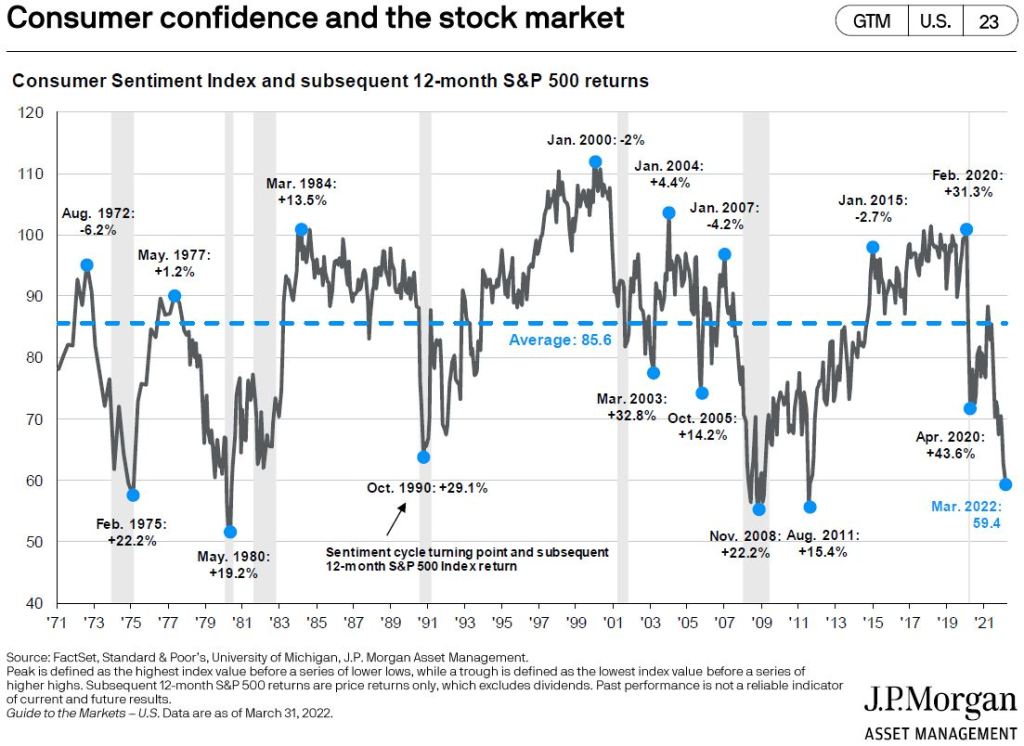
        J.P. Morgan has put together a chart of the Consumer Confidence Index and the subsequent 12-month S&P500 returns from January 1971 to March 2022:

        The chart shows us that when consumer confidence is high and there is a turning point in sentiment then the S&P500 usually does not provide much of a return in the following twelve month period. The outlier in this observation is February 2020 (the onset of the global COVID pandemic), when confidence was high and the market provided a one year return of 31.3%. I believe the reason for this outlier is that consumer confidence definitely turned negative after February 2020 but the unprecedented economic stimulus of governments around the world resulted in financial markets remaining strong. If you look at the negative points on the chart that represent a change of sentiment to more positive values then you can see that the resulting twelve month returns of the S&P500 are much higher. Currently, consumer confidence is low (59.4 compared to an average of 85.6) but no one knows if we are at a turning point today or if it will come tomorrow, next week, or next year.

        What I will say is that I’d rather continue to purchase shares in the great companies of today when confidence is low and uncertainty is high than the opposite. If your situation is the opposite, requiring income from your portfolio, then there are different strategies that exist to get you through these low-confidence periods of time. It could be as easy as putting aside a certain amount of cash, between 2 to 5 years, so that you can have the piece of mind that you do not need to sell shares of your existing portfolio at depressed prices to provide you with your required income.

        In closing, I could never say it better than some quotes from The Great Warren Buffet.

        “Today people who hold cash equivalents feel comfortable. They shouldn’t. They have opted for a terrible long-term asset, one that pays virtually nothing and is certain to depreciate in value.”

        “I will tell you how to become rich. Close the doors. Be fearful when others are greedy. Be greedy when others are fearful.”

        Want to chat about it? Email me at info@financerx.ca.