It’s Not a Matter of If, It’s When…

We are getting closer to the end of 2021 and the S&P500 index has put on an impressive year-to-date run of about 25%. November 18 marked the 66th record close for the S&P500 in 2021, with a closing value of 4,704.54, and the year isn’t over yet. The only other year in history that has a greater number of record closing highs is 1995, which had 77. My observation about years, such as this year, that result in lower than average negative volatility is that people suffer from amnesia about normal, and completely healthy, periods of market decline.

The monthly decline for the S&P500 in September 2021 was -4.65% and I can’t tell you how many clients had immediate anxiety that the value on their September statement had a lower value than their August statement. My answer to every client was the same, “has something materially change in your life? If nothing has changed then there is no reason to panic or change your investments. The market pulls back, on average, 14.3% every year at some point during the year so September’s decline was actually only a third of the average decline that we experience every year. If the decline continues into a bear market then our bear market income strategy is already in place and ready so your income will remain unchanged and uninterrupted.”

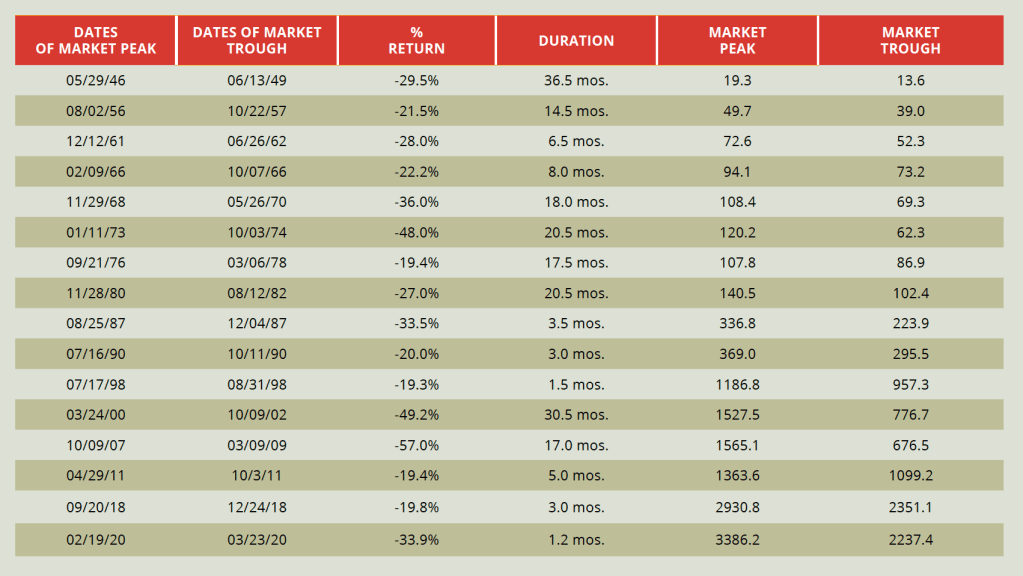
These calls prompted me to provide a bit of a history lesson; 75 Years of Bear Markets. Taking the direct definition from Investopedia, “a bear market is when a market experiences prolonged price declines. It typically describes a condition in which securities prices fall 20% or more from recent highs.” Over the course of the last 75 years we have experienced 16 bear markets and all of them have had a variety of lengths and temporary declines. This works out to an average occurrence of a bear market about every 5 years. The average bear market decline is -30% but there have been numerous times where the decline has only touched the official -20% mark mid-day but it also has been as traumatizing as -50% (2000). The average duration from the market peak to the beginning of the recovery has been around 13 months but it has been as short as 1 month or as long as 3 years. I’m going to say this again so that it can sink in, the average decline experienced in a bear market is -30% and it happens, on average, once every 5 years. If you aren’t absolutely confident that you won’t make an emotional decision and sell at a loss once you see your portfolio temporarily lose 1/3 of it’s value then investing in equities might not be for you. If you make the wrong decision and sell at the wrong time then it may be a mistake that you will never recover from. Bear markets are impossible to predict but they are something that you can plan for. Having a knowledgeable advisor in your corner, who has seen these types of markets before, can also be a big help to get you through the emotional experience that comes with a bear market.

If you are reliant on the reoccurring income from your investment portfolio then one option is to keep enough liquid cash reserves (or cash equivalents) on hand to get you through the worst of the decline so that you can shut off the income from your investment portfolio and allow it to recover. Another option for investors that do not want to keep a lot of cash on hand (especially in our current low interest rate environment) is to have access to a low interest rate line of credit, which can be utilized to replace the regular income from your portfolio. In terms of taking advantage of lower prices, you might not have any extra money to add to your portfolio but you can switch your portfolio’s dividends to reinvestment so that you are still purchasing additional shares of great companies at depressed prices.

If you are still accumulating assets then any bear market is a buying opportunity and you should never let the opportunity pass you by, even though your emotions may be screaming otherwise. Shelby Cullom Davis, who was an American businessman, investor and philanthropist, stated it perfectly when he said, “you make most of your money in a bear market, you just don’t realize it at the time.” The fact is that you will probably never see these “on-sale” prices again for the great companies that make up the market so do not let the buying opportunity pass you by. Look back at the chart I provided and look at some of the values of the S&P500 in the “Market Trough” column and now compare that to the closing value of 4,704.54 on November 18, 2021. Looking at the most recent bear market, which was a result of CoVid, if you would have taken advantage of that buying opportunity then you have experienced a gain of over 100% in about a year and a half.

No one can tell you when the next bear market will be, what will cause it, or how long it will take to recover but I can tell you with 100% certainty that there will be another one at some point in the future, we will get through it, and the market will achieve additional record highs after it is over.

If you need help preparing your own personal bear market income strategy then reach out to info@financerx.ca.

Don’t Be An Ostrich

It’s actually a fallacy that ostrich’s bury their head in the ground but have you ever had a problem in your life that you try to avoid at all costs so you just choose to ignore it? We all do it and we all know that it usually makes the problem worse and we still make that choice rather than face our problems head on. The problem that I am specifically talking about today is goal-planning. Everyone’s goals are different but the requirement of having specific, measurable, and attainable goals should be the same for everyone.

Here are some examples that I hear regularly, “I want to be able to help my children with their education,” or “I want to be comfortable in retirement.” These are not goals, they are statements.

Let’s start with the statement, “I want to be able to help my children with their education.” This statement just opens the door to many other questions. Do you want to utilize an Registered Education Savings Plan or a form of low-interest debt? Both? Do you know how to take full advantage of the government bonds and grants? Do you expect your child to pay a portion of their expenses? Do you expect them to get their education in the same city as you live or what if they decide to move somewhere else in Canada (or do a year abroad)? What programs do you think they will be interested in? These are just some questions to get you thinking. There is a vast discrepancy in the cost of different forms of education that are available and you don’t need a degree in math to budget for their education but it definitely helps if you ask someone knowledgeable in that area for help. Remember in the beginning of the article when I talked about goals being specific, measurable, and attainable? Here is an example of a goal regarding education, “I want to ensure that I can provide my child (who is 5 years old today) with at least $10,000 per year for 4 years to help with their education after they graduate primary school.” This goal is specific because it says how much, when it is to be paid and for a specific duration of time. This goal is measurable as the progress can be tracked over time. This goal is attainable due to the fact that it doesn’t require an unrealistic outflow to achieve this goal. In this example, the child is 5 years old and the goal is achievable by their 17th birthday by investing around $200 per month into a moderate investment from the age of 5 in a RESP until the end of the year in which the child turns 13.

Now on to setting a goal for retirement, but we will start with one of the statements that I usually hear, “I want to be comfortable in retirement.” This does not give any insight into what you are trying to accomplish. Are you talking about creating a multi-decade inflation-adjusted income that will last for the rest of your life or are you talking about the La-Z-Boy chair that you plan on purchasing for your living room? How about something along the lines of this, “I would like to be able to achieve an after-tax, inflation-adjusted income of $5,000 per month (in today’s dollars) starting from age 65 and last me until age 100. I am open to downsizing to a condo upon retirement so that I can travel stress-free and help fund my retirement expenses. I want to ensure that I have enough money saved so that I have the choice of hiring in-home care after the age of 80 and I want to leave a $500,000 legacy for my children.” This statement is very specific, can be measured as time goes on, and is attainable. You may currently be in retirement, be close to it, or it may be a distant hope but everyone should, at the very least, be thinking about it. There is no “too-late” when it comes to retirement but the more time that you have before that day then the more options that you have to achieve your goals.

The chance of your life happening exactly as planned is next to zero and these are just some pointers as to how to create a real goal. The true value in setting goals and the creation of a plan to achieve those goals is through revisiting and revising both as time goes on. Our lives are dynamic and ever-changing and so-should your goals and plan to achieve those goals.

Our lives equate to the sum of every decision that we make along the way and you have all the power to guide your own personal results. Don’t be an ostrich and let time and the rest of the world pass you by while you have your head in the sand.  

If you need help creating a vision for your own personal multi-decade journey then feel free to reach out to info@financerx.ca.

Fall Back to your Budget

This past Sunday marked the end of Daylight Savings Time (DST) so everyone’s clock reverted by one hour and you got an extra hour of sleep. It’s funny that we are even still participating in this semi-annual chaos on our internal body clock. The whole reason that DST was created was during World War I to try to save energy. Just like income tax, it’s an artifact of global war.

During the fall months, instead of waking up and using electricity before sunrise, you are technically sleeping in for an additional hour and are able to wake up closer to sunrise. But now it is technically an hour later when you get off work, meaning that you are contending with the darkness for your commute home and your free time after work, so you are probably using more electricity overall. DST’s fall-back results in a decreased overall exposure to sunlight during the normal hours of free time, which only amplifies the effect of Seasonal Affective Disorder (SAD).

SAD is a direct result of less exposure to sunlight, which negatively effects our mood and can lead to feelings of drowsiness and depression. A 2017 study found that hospital visits for depression increased by 11% around the time of transition from DST to standard time. The study finds evidence that the distress associated with the sudden advancement of the sunset, marking the coming of a long period of short days, to explain the up-tick in hospital depression visits.

This leads us to preparing for the coming of shortened days and the eventual increased expenses at Christmas time. Unfortunately, we can’t make the days any longer but we can help some of the pain that comes along with Christmas over-spending through money management over the course of the next six and a half weeks. Is there anything that you can cut out of your normal spending routine for the time being? Review your regular subscriptions like cable packages, streaming services, unused gym memberships, or expensive meal kits. Can you forgo going out to eat and drink with friends and have them at your house instead? If there is something expensive that you want to purchase then you can utilize a “cooling off period” for a couple of days to see if you actually need that product or service.

We know that the next few months are going to be filled with more hours of darkness but you don’t have to magnify the effects of SAD with guilt and anxiety from having to play catch up in 2022 to pay for Christmas overspending too. Every dollar counts and you’ll thank yourself for whatever the amount that you can save over the coming weeks.

Want to chat about it? Email me at info@financerx.ca

It’s Beginning to Look a Lot Like …. End of Year Planning

Well, it is officially November, which means that the weather is changing and you are probably thinking about travelling to a beach somewhere. November also means that you should start to think about things that need to be completed before the year is over or early next year.

Several deadlines that come to mind for the end of December include Tax Loss Selling, Charitable Donations, and Conversions from an RRSP into a RRIF for anyone born in 1950.

Tax Loss Selling is the opportunity to sell any investments in a Non-Registered account that are currently at a loss. These losses can be used to offset any taxable capital gains in any of the three preceding years, the current year, or they can be carried forward indefinitely. The settlement of selling the investment must take place before December 31 so, if the stock is publicly traded then, you must place the sale order no later than December 29. There are special rules called “Superficial Loss” rules for buying the investments back so an easy rule to follow is to wait 30 days before buying the security back to avoid the risk of the capital loss being denied by CRA.

Charitable Donations allow you to receive federal and provincial tax credits that can result in large tax savings. The first $200 that is donated is given a small tax credit and then the remaining amount of the donation is given a higher tax credit. In B.C., if you were to donate $1,000 in 2021 then you can potentially get a combined federal and provincial tax credit of $406. The last day to receive credit for 2021 donations is December 31 but donations can also be carried forward for up to 5 years.

If you were born in 1950 then you must convert all registered investment accounts. This means that all of your Registered Retirement Savings Plans (RRSPs) and Locked-In Retirement Accounts (LIRAs) must be converted into Registered Retirement Income Funds & Life Income Funds, respectively. At a minimum, you will be required to take 5.28% of the value of these accounts on December 31 as income in 2022. For example, if your RRSP was converted into a RRIF and it had a value of $100,000 on December 31, 2021 then at some point in 2022 you would be required to withdraw $5,280. This income is 100% taxable in the year that it is received. **If you have already turned 71 this year (or will be turning 71 before December 31) then you are still eligible to contribute to your RRSP for the 2021 tax year but you must complete the contribution prior to year end.

New Year, Same Reminders

January 1 marks a new tax year but it should also mark some of the usual reminders for you too. A new year means another annual top up for Tax Free Savings Accounts, Registered Education Savings Plans, and Registered Disability Savings Plans.

The Government has not officially come out with their Tax Free Savings Account contribution limit for 2021 but it shouldn’t be too long before they make their announcement. If you were over the age of 18 in 2009 then you have accrued a total TFSA contribution limit of $75,500 up to the year 2021, which was an additional $6,000. If CRA announces that 2022 will have a contribution amount of $6,000 then it will bring the total allowable accrued TFSA contribution limit to $81,500 but there is a potential that they may increase the 2022 contribution limit to $6,500 due to the annual inflation adjustment that they factor in. Tax Free Savings Accounts are one of CRA’s greatest gifts to Canadians as it allows you to invest and shield all capital gains from tax but, in terms of estate planning, it also allows you to pass money to your heirs without being subject to probate or tax.

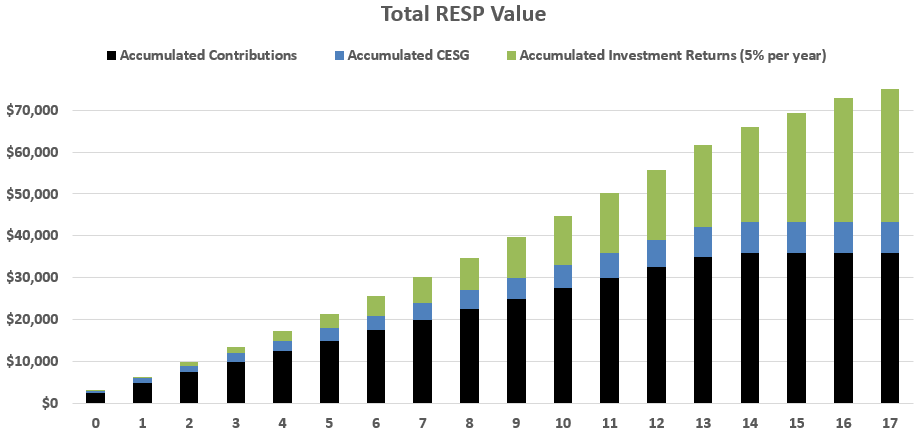
Registered Education Savings Plans have an annual limit of $2,500 that you can contribute per beneficiary. This would result in an automatic Canadian Education Savings Grant of $500. There is the potential of making up for previous years that may have been missed and I have included a link to my RESP article that goes into this in greater detail.

Registered Disability Savings Plans are a fantastic way to help a Canadian family member that has disabilities save for their future. This type of account allows the beneficiary to defer all accrued tax until a withdrawal is made. The Canadian Government also has grants and bonds that can be utilized. Under the Canada Disability Savings Grant, depending on the beneficiary’s adjusted family net income and the amount contributed, the Government will match contributions by 100% – 300% of the amount contributed, up to a maximum of $3,500 in one year and up to $70,000 over the beneficiary’s lifetime. The Canada Disability Savings Bond is meant to assist low-income Canadians with disabilities and will pay a bond up to $1,000 a year, up to a lifetime bond limit of $20,000. No contributions are required for the CDSB.

Want to chat about it? Email me at info@financerx.ca
The Invisible Thief

We’re all living longer and we can thank technology, medical, and public health advancements but are you ready for it?

In Canada, in 1950, the average life expectancy from birth was 68 years and by the year 2000 the average life expectancy had increased to 79 years old. The U.N. projects that by 2050 the average Canadian will live to be 86 years old. If the projections hold true then life expectancies over the course of the century will have increased by 18 years, or almost two decades! This is something that we should all be very happy about as it means that we have more time to grow our minds, families, and our legacies but this increase in life expectancy can also be a curse if you aren’t prepared for it.

You’ve probably heard your grandparents or parents say, “in my day, a chocolate bar cost a dime,” or something else along these lines. Inflation is known as “the invisible thief” because you can’t see it, and (most of the time) you probably won’t notice it in your day-to-day lives, but it’s always there and is defined as the general rise in the prices of goods and services in an economy. Simply put, the amount of things that you can buy with $20 today will be less than what you can buy with $20 in years to come. Using 1950 as our baseline, Canadian inflation has averaged at a rate of 3.52% per year. By applying the average, we see that you need $10.95 in 2021 to purchase the same amount of goods that $1 would have purchase in 1950.

In Canada the average person retires at the age of 64, which means that they will need to have an adequate nest egg to live on for approximately 20 years. Bear in mind that I am using the average and 50% of people will need to have enough of a nest egg to last even longer than two decades. We are fortunate to have Government Pensions in Canada but they are only meant to replace some of the income that you lose once you make the decision to retire. In 2021, the average Canadian earns $14,858 total from CPP & OAS, which works out to $1,238 per month. Think about your day-to-day life and imagine how difficult it would be to live on that amount. Luckily for us, the CPP & OAS are indexed to inflation so “the invisible thief” doesn’t get a piece of this over time.

Let’s look at the math… the average income for a full-time worker in Canada is around $55,000 gross per year and we know that the average Canadian will have to fund a retirement of around 20 years. Using the historic average Canadian inflation rate of 3.52% then we see that someone starting their retirement today with an income of $55,000 per year will need an income of $109,862 per year after 20 years of retirement to buy the same amount of goods and services.

The only way to outrun “the invisible thief” is to ensure that you are earning at least 3.5% annually on the money that you are saving for your future. Today, achieving an interest rate even close to 3.5% per year in a savings account, GIC, or government bond is impossible so, unless the funds are earmarked for something specific in the short-term, the only way to ensure that you aren’t effectively losing money over time is to invest. I’m not talking about investing in the newest “hot stock” that your neighbor, colleague, friend, or financial television network pitches you. As well, I’m not saying that you won’t potentially get lucky by taking stock tips from people in your life but this is akin to gambling and I can’t provide advice on where the ball will land in a game of roulette either. I’m talking about a globally diversified investment solution that invests in corporations with a reputation for quality, reliability, and the ability to operate profitably in good and bad times.

A diversified investment solution is a means of achieving your goals but a financial plan is the map of how you get there. No plane takes off without a flight plan and no ship sets sail without a plotted course. No flight plan or plotted course is followed exactly either and there will be numerous challenges and course corrections that will need to be addressed during the journey. This is why it is so important to have a plan but it is even more important to update the plan (at least annually or whenever a material change occurs in your life). You shouldn’t embark on a multi-decade retirement journey without a plan as to how you are going to get there, what sort of obstacles that you may encounter along the way (possibly downsizing, dealing with health challenges, sickness & survivor planning) and what sort of legacy you want to leave behind to your heirs (estate planning with a focus on tax efficiency).

If you need help creating a vision for your own personal multi-decade journey then feel free to email info@financerx.ca.

Market Negativity

As Normal as the Leaves Falling off of the Trees in Autumn

JP Morgan has released their quarterly Guide to the Markets and if you are a client of mine then you will be accustomed to this graph. This graph provides us with a ton of valuable information about the returns of the S&P500 (a stock market index that tracks the performance of 500 large companies listed on stock exchanges in the United States).


The grey bars show the annual return of the S&P500 in any given year. For example, we can look at the bar on the farthest right (YTD), which signifies 2021 from January 1 – September 30, and we see that the S&P500 had a YTD return of 15% on September 30, 2021. Now, look at the -5 red dot under that respective bar, which signifies the lowest point that the market achieved over that calendar year on a percentage basis. Look at the bar directly left (which signifies CoVid – 2020), we can see that the market achieved a fantastic return of 16% by the end of 2020 but experienced a decline that equated to -34% during the year.


Let’s zoom out a bit and look over the entire graph rather than focusing on one specific year. I would suggest that you do the same when you evaluate your investments because you are a multi-decade, potentially trans-generational, investor so the most recent Armageddon Du Jour that the media is latching onto shouldn’t be new to you; it’s one of the same from the past but simply rebranded. The entire graph shows the returns of the last 41 years and we can see that every single year (41 out of 41 years) the market was negative at some point in the year. Market negativity is normal and should be expected, the same way that the leaves fall off of the trees in autumn or plants begin to sprout in Spring, and anything different should be considered to be an anomaly or not normal. Market negativity at some point in a calendar year may be normal, but if history tells us anything then we should understand that market positivity is also normal. Over the same course of 41 years, the annual returns of the market were positive 31 out of 41 years (75% of the time). The market returned an average annual return of 9% per year from 1980 to 2020 and you can increase that average annual return to around 12% per year if you account for reinvested dividends.

As humans, we are hardwired to feel something and then believe that we need to act on our emotions. This instinct may have saved us when we heard foreign noises in the wilds of the past, when this noise was a threat such as a lion or other predatory animal. This instinct is also one that can wipe out decades of investment returns and put your future in jeopardy if you make the wrong decision at the wrong time. The market isn’t risky, human nature is risky.

If you believe that you are at risk of making an impulsive investment decision during stressful times, which we have determined happens every single year, then working with a professional can help you get through these stressful times.

“The four most dangerous words in investing are, it’s different this time.” –Sir John Templeton

Want to chat about it? Email me at info@financerx.ca

R.E.S.P

No, I’m not starting to sing Aretha Franklin’s hit song, RESPECT, but I have to admit, even as a financial planning professional, RESPs are one of the most confusing investment products in Canada. I find that people have a basic knowledge of them but they may not know how to ensure that they are fully utilized to provide the maximum benefit possible. The government has a website that provides some insight but it can seem clear-as-mud once you start to delve into the details. I have included the link here.


A RESP is short-form for a Registered Education Savings Plan and it is used to help a child with costs that may be associated with a post-secondary education at an eligible education institution. CRA has a list of designated education institutions and they include apprenticeship programs, trade schools, colleges, and universities. A parent can open a RESP for a child but they also have an option to open a Family RESP so that all of the money is pooled in one account and the contributions/investment growth can be utilized by all of the siblings. Anyone can open a RESP in the name of a child, whether it is their child, grandchild, niece, friend, or other relative but we usually recommend that the parent of the child is the registered contributor on file other than in special circumstances. The benefit of the RESP is the fact that the Government of Canada will deposit money into the RESP (in the form of bonds or grants) and these benefits rely on either the amount of contributions that you make annually or the level of income that you have in any given year. If you live in British Columbia or Saskatchewan then there are some Provincial grants that you can utilize but I won’t be getting into the specifics of these in this article. Feel free to reach out if you want to talk about them.


The first federal government benefit, which does not require any money to be actually contributed, is the Canada Learning Bond (CLB). This is meant to help lower-income families put away for a child’s education. A child’s CLB eligibility is only based on the adjusted net family income per year and the number of qualified children in the family. For example, in 2021, if you have between 1 to 3 children and have an adjusted net family income of less than $49,020 then your children would be eligible for the bond this year. The CLB contributes up to $2,000 to an RESP for every eligible child ($500 for the first year of eligibility and $100 each year after as long as the child continues to be eligible up and including the year in which they turn 15).


The other federal government benefit is known as the Canadian Education Savings Grant (CESG) and the amount that your child will receive for this grant is determined by the amount that you have contributed to the RESP in a given calendar year. Essentially, the federal government will give you a grant that equates to 20% of your annual contributions (up to $500 annually). This means that if you contribute $2,500 over the course of a calendar year then the government will give you $500 but if you only contribute $1,000 over the course of a calendar year then the government will give you $200. You can make up for years in which you may not have contributed the maximum but only up to a maximum grant of $1,000 per year. The lifetime CESG maximum that the government will give per child is $7,200. If your child is turning 16 or 17 in the current calendar year then to be eligible to receive the CESG there are a couple different terms. Either the child must have had a minimum of $2,000 in contributions to an RESP before the end of the calendar year in which they turned 15 or a minimum of $100 in annual contributions was made in any four years before the year in which the child turned 15. This can all seem very confusing so if you would like any clarification then feel free to reach out using the form at the bottom of this post.


I’ve heard many people say that RESP accounts are just too confusing so they don’t bother with them but these people are potentially missing out on a large benefit when the beneficiary of an RESP chooses what direction they would like to go after high school. If we assume that the child will only receive the CESG and the RESP will earn only 5% on average per year then, by the time the child has reached the adulthood, the contributor would have contributed $36,000, the government would have contributed $7,200, and the investment growth would equate to around $33,300 for a grand total of $76,500. This means that of the $76,500 potential future value of the RESP only 47% was contributed from your own pocket. I’m sure many of the parents reading this wouldn’t mind that kind of extra padding when helping out their child.

Another excuse that I hear about the RESP is that the RESP proceeds are too restricting and must be used on tuition or other specific school related expenses but this is not the case. A withdrawal from the RESP only requires evidence that the child is in a designated education program and then the funds from the withdrawal can actually be used on anything that the child is in need of. Does your child need a car to get to classes? Do they need assistance paying their rent? How about a laptop or meals or furniture for their new apartment? The proceeds from the RESP are actually very flexible as the government doesn’t require any receipts or record of what the funds were spent on.


One last excuse is based on the “penalty” that has to be paid if the child does not end up going to a designated education institution. An individual or family RESP can stay open for 36 years so maybe they don’t know what they want to do today but that does not mean that they won’t in the future. If you didn’t want to keep the RESP open then you can actually collapse the RESP too but the government will claw back all of grant money that they deposited over the years. All of the contributions that you made are returned to you (without tax or penalty). Lastly, the proceeds from investment are subject to tax (in the hands of the contributor) plus a 20% penalty UNLESS you have contribution room and are eligible to contribute to your RRSP (under the age of 72), in which case you can simply contribute the proceeds on save on your next tax bill. This type of transfer to the RRSP is limited to $50,000 per RESP.

Want to chat about it? Email me at info@financerx.ca

There’s No Place Like Home

This is how a lot of Canadians think when it comes to their investment portfolios, even if it is complete instinct. Canadians, just like the majority of at-home investors around the world, are guilty of having home bias in their portfolios but knowing what it is can help deter you from making it worse. Home bias is one of the many emotional biases that are natural to human behavior but can end up being a determent to your investment performance over a long period of time. Home bias simply means that an investor has a natural inclination to invest in domestic securities rather than foreign securities. The average Canadian has around a 30% allocation to Canadian securities in their investment portfolio but the performance of the Canadian economy only makes up about 3% of the global economy. One of the many reasons why this occurs is the fact that we feel more comfortable with familiarity. We feel more comfortable when we are investing in household names that we see often in our day-to-day lives.

The FTSE (Financial Times Stock Exchange Group) All-World Index and the MSCI (Morgan Stanley Capital International) All-Country World Index are two different indices that are meant to replicate the performance of approximately 99% of all equity markets around the world. Delving deeper into the percentage breakdown by country across both of these indices, it is found that Canada makes up about 3% of the overall weighting. This means that the creators of these indices allocate 3% of the entire world’s stock market performance to Canada so, if you are looking at your portfolio from simply an asset allocation standpoint then, anything over a 3% weighting in Canada would be considered over-weight. Even our own Canada Pension Plan only invests 16.6% of their total assets in Canada.

The rationale as to why you have to be careful when you have a higher allocation in your portfolio to one specific country is due to the fact that not every country’s stock market is the same. If we look at the S&P/TSX Composite Index, Canada’s benchmark index, then you’ll find that Financials (31%), Information Technology (12%), Energy (12%), and Industrials (12%) are the largest 4 sectors and they make up 67% of the overall index. The smallest 4 sectors are Customer Staples (4%), Consumer Discretionary (4%), Real Estate (3%), and Health Care (1%) and only make up 12% of the overall index. The MSCI All-Country Index’s top four sectors are Information Technology (22%), Financials (14%), Consumer Discretionary (13%), and Health Care (12%), which makes up 61% of the index. The bottom four sectors of that index are Materials (5%), Real Estate (3%), Energy (3%), and Utilities (3%), which only make up 14% of that particular index.

The result shows us that by investing only in the S&P/TSX then you are overweight Financials by 17% and Energy by 9%. You are underweight Healthcare by 11%, Information Technology by 10%, and Consumer Discretionary by 9%. All that this means is that Canada’s economy is not an exact replica of the world economy. By having a higher allocation in your investment portfolio to Canada then you may feel more comfortable but you will also have a heightened level of risk due to the fact that your investments will have a heightened reliance on the performance of Canada. You are already reliant on the Canadian economy for your income (if you are working) or your pension (if you are retired) so, as a result, wouldn’t you want to minimize your investment portfolio’s reliance on the Canadian economy too?   

As a Canadian, there are many reasons as to why you would have a higher allocation to Canadian securities in certain accounts. Everyone knows the level at which interest rates are at currently (record lows) so investor’s don’t have many alternatives to investing in equities when the average long-term inflation rate in Canada is around 3%. This means that if you aren’t earning more than 3% per year (after-tax) on your money then you are effectively losing purchasing power over time. Another reason is due to the fact that the S&P/TSX provides approximately 2x the yield (dividends) compared to the S&P500 so Canadian investors that are searching for dividends don’t have to look far to find some high dividend paying companies. Lastly, Canadian dividends provide a tax-efficient source of yield for Canadians. If you are receiving your dividends in a non-registered investment account then the difference in marginal tax rates between Canadian eligible dividends and foreign dividends can be as high as 20% in some provinces (without even taking the additional withholding taxes applied against foreign securities into account).

Understanding the benefits and drawbacks of having an investment portfolio that is guilty of home bias is a step in the right direction for any investor. The goals of every investor are different and there is no one-size-fits-all solution so due diligence is recommended before making any changes to your portfolio.

All percentages and sector allocations discussed are as of August 31, 2021 and are subject to change.

Want to chat about it? Email me at info@financerx.ca

Let’s Play a Game

You have two choices, I’ll give you $1,000,000 today or I’ll give you a magic penny that doubles in value every day for one month. Which would you choose?

As of March 2021, Warren Buffett was ranked 6th on Forbes’ List of the Richest People In the World, with a net worth of $96 billion dollars, but did you know that he actually earned 99% of that value after his 50th birthday? Buffett started buying stocks in his teenage years and amassed a net worth of $140,000 by the time that he reached the age of 26. It didn’t take him long after that to reach his first million, achieving it at age 30, and then proceeded to turned that into a billion in the midst of his 50’s. If Buffett would have taken an extra decade to earn his first million, or had retired in his 60’s and stopped investing, then his situation would be a lot different and he would probably not be such a household name. Buffett’s secret is the fact that he started investing very early and built his fortune slowly over time through the power of compounding. How suiting is it that his biography is called “The Snowball”…

“Compound interest is the eighth wonder of the world. He who understands it, earns it… he who doesn’t, pays it,” is a quote from Albert Einstein. Simply put, the actions that we take today can have a profound and large benefit (or detriment) to our future selves. You can be-like-Buffett and help your future self by investing today or, alternatively, you can put yourself in a worse situation by not understanding the long-term effects of a high interest rate loan with compounding interest (like credit card debt).

The problem lies at the root of humanity due to the fact that, as humans, we are hardwired to be immediate pleasure seekers. It is very difficult for us to delay gratification into the future and the different parts of our brain are constantly battling to sway your decision in their favour. We have an emotional aspect, which wants the pleasure now, and is the key driver of sudden impulses. Then we have the logical part, which is trying to reason with the emotional side to think about the future and the consequences of our actions. We need to be in the right environment to make the right decisions and we need to keep the emotional side of our brain satisfied, thereby assisting the logical side. For example, if you tend to over-spend when you grocery shop due to buying things impulsively then maybe it is a good idea to order your groceries online and simply pick them up but allow yourself to buy one ‘treat’ to satisfy your emotions. A similar idea can be applied to investing; if you know that you will spend the money in your bank account then you should start a regular investment plan that automatically transfers funds to your investments as soon as a payroll deposit is received. Automation is the key here, as it takes our emotions completely off the table. Just by understanding this concept and trying to think of the tasks in your daily life as a struggle between impulse vs. logic will help with your decision making.

So, back to the game, would you rather have $1,000,000 today or would you rather have a magic penny that doubles every day for one month? As you can probably guess, you are actually much better off by avoiding the impulsive decision to take the million now but I’m sure you still thought about it (right?).

Don’t believe me? I’ll break it down for you.

Another thing that I didn’t specify is the month that the magic penny will be based on but, as you can see, it doesn’t matter. Whether it is a month that has 28 days (like February) or one of the many with 31 days, the correct decision always lies with the magic penny. The penny takes 28 days to surpass the up-front one million dollar prize, which is one of the reasons that makes investing so difficult.

The key take-away is that it doesn’t matter how much you are putting away today as long as you are still putting away and investing; a penny today has the potential to be a dollar in your future.

Want to chat about it? Email me at info@financerx.ca
CPP / OAS : To Delay or Not to Delay – That is the Question

The Canadian Pension Plan (CPP) is one of the retirement income cornerstones for many Canadians. Every year that you are working, regardless of whether you know it or not, if you earn more than the annual basic exemption income amount ($3,500 in 2021) then you must contribute to the CPP. If you are employed then you must contribute 5.45% of your earned income, up to the designated maximum annual pensionable earnings, and your employer must contribute a matching amount each year. In 2021, if you have an income over $61,600 in pensionable earnings then you have maximized your CPP contribution for this year, which is $3,166.45 for 2021. If you are self-employed then you will contribute the employee and the employer portions on your own (10.9% of your earned income, up to a maximum of $6,332.90). More information about CPP can be found on the Government of Canada website. (https://www.canada.ca/en/services/benefits/publicpensions/cpp.html)

How much you will actually receive from CPP in the future will depend on several factors. The main driver is how much you contributed to the CPP over the course of your adult life (starting at age 18 and ending as late as age 70, if you are still working and choose to maintain your contributions after age 65). CPP uses a formula to calculate your pension benefits but, simply, if you contributed the maximum amount for 39 years then you will earn the maximum CPP pension benefit. There are several other factors that can also affect your pension amount, such as working while receiving the CPP pension benefit and continuing to contribute after age 65 or if you have had periods of low or no income due to raising children or being temporarily disabled. Regarding the latter, you are responsible for notifying Service Canada for these particular periods of time.

It may feel like you’ve worked your entire life so you may believe that you should be entitled to earn the maximum CPP benefit available but only a very small percentage (around 6%) of Canadians actually earn the maximum benefit. For 2021, the monthly maximum amount you could receive as a new CPP recipient starting at age 65 is $1,203.75 but the actual monthly average of all Canadians receiving CPP is $619.44 per month. This results in an annual income difference of over $7,000 per year when you compare the maximum to the average Canadian pensioner. Your CPP payment is indexed to inflation, which means that your benefits will increase annually due to an increase in the Consumer Price Index (CPI), which allows your benefits to keep up with the cost of living. If the CPI decreases over a 12-month period then your CPP benefit will not decrease.

The easiest way to find out your own estimated personal CPP pension benefit is to logon to Canada’s MyServiceCanada Account (https://www.canada.ca/en/employment-social-development/services/my-account.html). If you do not have online access then you may call Service Canada at 1-800-277-9914 and you can ask for your CPP estimate.

Now, let’s talk about when you can actually start to receive your CPP. Service Canada uses 65 as the base-age for benefits but you have the option of starting to take your CPP as early as age 60 or as late as 70. If you take it early then you are penalized at a rate of 0.6% for every month prior to your 65th birthday, which results in an annual reduction of 7.2% off of your base benefit at age 65. This means that taking your CPP at age 60 will result in a reduction of 36% off of your base benefit. If you delay your CPP then you are awarded an increase of 0.7% for every month that you delay the benefit after your 65th birthday, which works out to an annual increase of 8.4%… (not a bad annual risk-free return when you compare that to what a guaranteed income certificate is paying today). If you were to delay receiving your CPP until age 70 then you would actually receive a 42% larger payment compared to your payment at age 65.

Let’s assume that you are forecasted to earn the maximum CPP benefit at age 65, which is $1,203.75 per month ($14,445 annually). This chart shows how much you would earn per year based on if you started your CPP benefit as early as age 60 or as late as age 70. As you can see, even if you are going to receive the maximum CPP benefit at age 65, if you choose to take CPP at age 60 then you will only actually earn $770.40 per month ($9,244.80 annually) and if you choose to delay receiving CPP until age 70 then you will earn $1,709.33 per month ($20,511.90 annually).

Old Age Security (OAS) is more standardized for Canadians and provides a base level of retirement income to Canadians. Old Age Security is Canada’s largest pension program and (unlike CPP) you are not required to pay into the plan over the course of your life. The amount that you will receive with OAS is dependent on how many years you have resided in Canada as a Canadian citizen or legal resident after the age of 18. If you have lived in Canada for 40 years, after the age of 18, then you will receive the maximum OAS benefit. If your situation is different, whether you immigrated to Canada as an adult or moved away in your adult life, then you may still qualify for partial benefits based on when you moved to Canada and whether you have been here continuously since that date. More information about OAS can be found on the Government of Canada website. (https://www.canada.ca/en/services/benefits/publicpensions/cpp/old-age-security.html).

OAS, unlike CPP, can not be taken prior to age 65 but it can be delayed up until age 70. The current monthly maximum benefit for OAS equates to $626.49 per month ($7,517.88 annually). If you choose to delay your OAS then you will receive an increase of 0.6% for every month that you delay after your 65th birthday, which results in an increase of 7.2% annually. If you were to delay receiving OAS until age 70 then your payment would be 36% higher than compared to what you would have received at age 65. Your OAS payment is also indexed to inflation, which means that your benefits will increase quarterly due to an increase in the Consumer Price Index (CPI), which allows your benefits to keep up with the cost of living. If the CPI decreases over a 12-month period then your OAS benefit will not decrease.

Another factor that sets OAS apart from CPP is that the government will actually claw-back a portion (or all) of your OAS depending on your annual net income. This is known as the “Old Age Security Pension Recovery Tax.” This does not pertain to you unless your net world income is above a certain threshold ($79,845 for 2021). Your net world income refers to all of the income that you have earned world-wide AFTER taxes and deductions have been taken into account. If your net income is above this threshold then $0.15 of every dollar above the threshold is clawed back. For 2021, If your net world income is above $129,581 then your entire Old Age Security benefit will be clawed back.

Similar to CPP, I have created a graph that shows the difference in your annual OAS benefit if you were to choose to take your OAS at age 65 compared to delaying it until later into the future. As you can see, earning the maximum OAS benefit at age 65 will result in an annual benefit of $7,517.88 but, if you chose to delay to age 70 then, you could earn as much as $10,643.13 per year.

Everyone’s personal situation is different and there are many reasons (and financial planning strategies) that will determine why someone may choose to take their CPP early or delay receiving their CPP & OAS.

Want to chat about it? Email me at info@financerx.ca