Our lives are rarely static for long periods of time. Change can occur due to outside forces that we can not control or it can occur from a direct choice that we have made so if you continually expect change to occur frequently in your life then it will be less surprising when it occurs. The reason that I bring this up is because my partner and I recently adopted a puppy so the last few weeks have been very different from what we were used to. We have had to change our sleep schedules, our work schedules, our budget, and pretty much everything else that you could think of. The changes are welcomed but, as a financial planner, it means that every prior plan that I have made for our future requires some tweaks to reflect our current situation. Your chosen financial representative should understand this and they should encourage you to contact them to update your plan whenever a material change occurs in your life, especially one that will change your finances. Many different adaptations of your plan will need to be made over the course of your lifetime to reflect the changes that will occur.
Any change to your plan today, no matter how small, will have larger repercussions as you increase the length of time that you are planning for. This is a concept known as, “The Butterfly Effect,” which states that a small change today can lead to vastly different outcomes in the future. The main principle to keep in mind here is time. Time is one of our most valuable assets because it is finite and no one truly knows how much of it they have left. When it comes to investing, the length of time that you have to invest (called your investment time horizon) is going to be one of the most important variables in determining how to invest and what value to expect in the future.
When we are young, we have seemingly unlimited time but finite resources to do the things that we want to do. As we grow older, if we carefully plan, we should have all of the resources required to satisfy our wants and needs but it is time that seems to slip away from us. Time is valuable but its importance only becomes more clear as more of it passes us by. If only we could have told our younger selves to put away those extra dollars or make them think twice about a substantial purchase that was not truly needed. I know that my parent’s tried to do just that but, again, my younger self did not understand this particular relationship with time.
One exercise that I learned during the course of my career to show this relationship in a more tangible way is to think of a meter stick, just like the ones that you remember from your school years. A meter stick is one hundred centimeters long. In 2022, the average life expectancy in Canada is 83 years (rounded) so automatically cut 17 centimeters off the end of the meter stick. Now, think about how old you are today, and place a mental mark on the corresponding centimeter that represents your age. The distance from your mental mark to the new end of the meter stick, at 83 years, is the amount of time that you have left to live, on average. Just before your 21st birthday you’ve already burned up a quarter of your life and the middle of the way through your 41st year you will have reached your halfway point. This exercise can be eye-opening because many of us do not realize how quickly the distance to the end of the meter stick shrinks.
You may have been a late bloomer to have this epiphany about time as a resource but I can tell you that it is never too late to create a vision and a plan to achieve that vision. A plan, no matter how many times you are required to change it, is still the best way to ensure that you have the directions to navigate the tides of time to succeed in achieving the future that you envision. A vision without a plan is just an illusion and a plan without a vision is void of any feeling or emotion.
If you need help creating your own unique vision and subsequent plan then reach out to me at info@financerx.ca & if you are curious about our newest addition to the family, here is a picture.
Choosing the correct key people in your life is a big decision and is one that you should not take lightly. I’m talking about the person (or persons) that will make sure that your affairs continue to remain in order in the event of incapacitation and thereafter. A lot of people put more emphasis on choosing an executor than a power of attorney but more thought should be put on the latter instead of the former. The reason that I believe this to be the case is that if your power of attorney steps in to assist you then that means you are still living and your well-being will be determined by how well of a job that they do acting as your attorney. Once your executor must step in then you have passed on and what will be, will be.
You have many options for choosing these key people. You can choose family members, friends, or a professional (like a lawyer or a trust & estate corporation). As we know, most people choose family members but do these family members know what they are signing up for? Are they going to be able to do the best job possible if they live elsewhere or if they can not take the necessary time off of work to complete their duties? Most estates do not require a lot of time but it can be very time consuming if there is real estate or other physical-type assets involved (like art, collectibles, etc.).
Generally, a power of attorney does not get paid for their services unless it is written into the legal POA. They have a very important job though, including paying all bills, ensuring all your accounts are kept up-to-date, paying taxes, and buying and selling investments or even real estate. Their job is to make you a priority and ensure that everything that you need is taken care of.
An executor’s job is to secure all assets of an estate and then distribute them according to the deceased person’s wishes. They will follow what you have written in your Will and ensure that everything is dispersed according to your wishes. In regards to a fee, an executor in British Columbia can take as little as 0% but has the option of taking up to 5% of the total estate value. Bear in mind that any accounts that are held Joint with Rights of Survivorship do not pass according to your estate, as they become solely owned by the surviving account owners. Another thing to keep in mind is that any asset (such as a TFSA and RRSP/RRIF) does not have to pass according to your estate if you have named a beneficiary on these accounts at your financial institution.
Here are some things to keep in mind when you are choosing these Key People:
What sort of financial knowledge does this person have? How is their own financial situation?
How old are they today? How old will they be in the future if they have to step into either role?
Are they going to be available for you? Can they take time off of work if it is required?
Now, just because someone has chosen you to act as their power of attorney or executor that does not mean that you have to move forward with it. People need to keep this in mind because as soon as you begin to act as an attorney or executor then you are personally liable for the decisions that you make. You can pass the responsibility on to someone else or enlist the help of a corporation that specializes in these types of roles. All of the Canadian Chartered Banks have Trust & Estate Specialists that focus on these roles and can step in to assist. If you are concerned about any of the responsibilities required then why not enlist a professional? It is a huge responsibility to act as someone’s executor and attorney so think it through before you agree to anything.
Want some help developing your Estate plan? Email me at info@financerx.ca.
The creation of an efficient estate plan requires some thought and should be reviewed approximately every five years to ensure that no changes need to be made. I’ve found that most clients did not know that there are two different options when it comes to how estate assets and registered accounts are dispersed, Per Stirpes and Per Capita. Both options look the same up until the moment a beneficiary passes away and then you can see the clear differences.
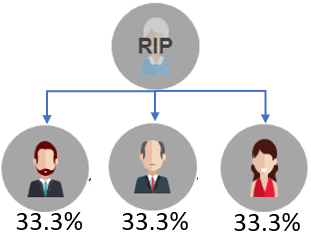
We all know how estate dispersions work but I have created a picture to make it easier (see below). Looking at the estate breakdown below, you will see that someone passed away and the estate is evenly split between three beneficiaries. This means that each beneficiary will receive approximately 33.3% of the total estate.
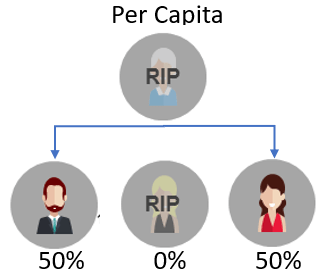
What if one of these beneficiaries happens to predecease the person at the top? If an estate is set up Per Capita, which is the most common, then if one of the beneficiaries were to pass away first then the estate would be distributed evenly amongst the surviving beneficiaries. You will see below that the two remaining beneficiaries now get to evenly split the estate between the both of them and the deceased person’s heirs receive none.
The other option, if one of the beneficiaries happens to predecease the person at the top, is know is Per Stirpes. Per Stirpes means that if one of your listed beneficiaries predeceases you then their portion will pass to their heirs, based on the deceased beneficiary’s Will. The Per Stirpes designation is most common when parent’s would like their assets to pass to their adult child’s family in the event that their adult child predeceases them.
Making sure that your Will and Registered Accounts are set up correctly will ensure that your distribution requests continue to be acted upon as you originally wanted them to be, even if one of your beneficiaries were to pass away. No one knows what the future holds and, especially as we age, you may find yourself in a situation where you can not update your will or beneficiary designations on your registered accounts.
For example, if someone is deemed by a doctor to have experienced a loss of cognitive functioning then their Power of Attorney (POA) may be asked to step forward to assist making financial and health related decisions. Once someone has been deemed incapable then their estate and account beneficiaries may not be able to be changed because it could be argued that the person is not of sound mind and, therefore, is incapable of making these types of changes. POA’s are not allowed to update someone’s will or change their registered account beneficiaries.
Understanding the difference between these two options for dispersing assets to your beneficiary will allow you to make a more informed decision and ensure that your estate plan is reflective of your issues.
Want some help developing your Estate plan? Reach out to me at info@financerx.ca.
It is very common for people to believe that they are making the best decision by adding their children as joint owners onto their real estate to potentially save some money and help streamline their estate. The two most common types of real estate are principal residences and rental properties. It may make sense for your situation to add someone on to a property’s title but it also opens you up to the potential for enormous liability if you are not informed before making this decision.
Principal Residence
As Canadians, we are very lucky to have a principal residence capital gains tax exemption. This means that your principal residence will be sheltered from any capital gains, which is the difference between what your house sells for and the adjusted cost base (the original purchase price plus any improvements, renovations, etc.). CRA only allows one principal residence per couple (married & common law). If the property is already joint with your living spouse and one spouse passes away then the property becomes solely owned by the surviving spouse without any tax or probate. If the home is still owned by the last surviving spouse upon their passing then the last surviving spouse’s executor will take over with handling the sale and will disperse the proceeds according to the last surviving spouse’s will. The property will remain exempt from any capital gains tax from the value on the day that the home was purchased up until the day of the last surviving spouse’s passing. The estate will incur capital gains tax on any gain that is realized on the difference in value from the day of the last surviving spouse’s passing up until the day that the property is sold. If the executor is handling the sale then that means that the property has passed according to a will, which means that it is subject to a probate fee. In British Columbia, the probate fee can be estimated to be around 1.4%. This means that an estimated sale price of $1,000,000 would be subject to a probate fee of around $14,000.
Rental Properties
Unfortunately, rental properties in Canada do not have any capital gains tax exemptions. This means that, unlike a Principle Residence, a rental property will be subject to income tax if it is sold for a higher value than what it originally cost plus any improvements, renovations, etc.. If the property is sold prior to the last joint owner’s passing then only income tax will need to be paid. If the property is sold by the executor of the last joint owner then it will be subject to income tax and probate.
Adding Children onto Properties
From the information about the different types of properties listed above, people may want to add their children on to the title of their homes to avoid probate in the case of a principal residence or probate and income tax in the case of a rental property. It seems like a great idea to add whomever on the title of a property and continue to defer any probate or income tax for future generations but if it seems like such a great idea then you should also realize that CRA would not allow it. CRA will always want their “pound of flesh” and there is no such thing as a free-ride in the eyes of the tax man. If you make any changes to whomever is listed on title then CRA may look at this like a deemed disposition, which means that any applicable capital gains may be subject to income tax. This would be unfortunate because the property was not actually sold so, unless you have the excess cash around to pay applicable tax from capital gains, then you will be left with a tax bill with no money to pay it.
Another issue that can arise is if the property is your principal residence because CRA only allows one principal residence per couple. This means that if you add someone on title and they already have a principal residence then you may put a portion of your principal residence income tax exemption in jeopardy for future years.
Lastly, and I believe this to be the largest issue, is that any jointly owned real estate may be looked at as each joint owner’s property. This means that if an account is joint then it may be at risk in divorce proceedings, bankruptcy court, and court injunctions. It would be rather unfortunate if you worked your entire life for your home to be paid off only to have to re-mortgage because your child went through a divorce, claimed bankruptcy, or was sued and lost.
All-in-all, without understanding your complete financial situation it is very hard to say whether it makes sense to add anybody onto the title of a property to try to avoid probate or income tax and no one should provide this advice to you without a complete understanding of your situation. This article is only meant to provide information so that all of the repercussions of any actions taken can be thought out beforehand. Do your research, ask the experts, and make sure that you have a complete understanding. Usually, there are a lot of inefficiencies in estate plans that are easier to minimize than something as big and risky as the one discussed above.
Want some help developing your Estate plan? Reach out to me at info@financerx.ca.
Part 1 of my Estate Planning series will go over the types of assets that pass through a Will and which assets do not have to pass through a Will.
It isn’t uncommon for people to think that every asset passes through their Will and therefore needs to be added to their Will, but this is not the case, and it may actually save some money for your estate if the asset doesn’t. In this article I am going to discuss the assets that pass through a Will and assets that do not have to pass through a Will. Bear in mind that anything that passes through a Will is subject to probate. Probate is a process through the provincial courts that verifies that a will is real and is the most up to date version. The cost of probate in British Columbia can be estimated to be around 1.4%, meaning that anything that passes through a will is subject to this cost. Income tax may also be a concern too but this depends on the type of asset or type of account.
Non-Registered Investment Accounts / Bank Accounts : If these accounts are solely owned then they will pass according to the account owner’s Will and be subject to probate. Alternatively, these accounts may be set up as Joint with Rights of Survivorship, which would result in the account becoming the sole property of the remaining account holder(s). Joint accounts are not subject to probate costs as they do not pass according to a Will.
Real Estate : If it is solely owned then it will pass according to your Will and will be subject to probate. Real estate can be a jointly owned asset too. Jointly owned real estate may be set up as Joint with Rights of Survivorship, which means that the remaining account holders will take over the deceased owner’s portion. Jointly owned real estate can also be set up as Tenancy in Common, which means that the portion owned by the deceased will pass through the deceased’s will to their heirs and will be subject to probate. If the real estate is solely owned or is set up as tenancy in common then there will also be income tax that will need to be paid by the estate, but only if the property does not qualify for Canada’s coveted Principal Residence Designation.
Art, Collectibles, & Antiques : These unique assets will pass according to the deceased’s Will and will be subject to probate based on their estimated value. This classification of items is known as “personal use property” and income tax in the form of capital gains or losses will also have to be taken into consideration. Under income tax law, you are assumed to have ‘sold’ these types of assets at fair market value the day before you pass away, and the difference between your accrued cost basis and the estimated fair market value will be included as a capital gain or loss on your terminal tax return. I’ll add that this classification of assets can cause a lot of chaos between estate beneficiaries if the Will is not specific as to whom you would like to give the individual pieces to or if you wish for them to be sold by the executor and the proceeds dispersed to the beneficiaries of the Will. There may be a high emotional value or a high actual monetary value attached to these types of assets and it isn’t uncommon for these types of assets to lead to arguments among family members. The deceased’s instructions should be very clear as to the handling of these types of assets.
Tax Free Savings Accounts (TFSA) : These accounts have the option of passing through a will by listing the estate as the beneficiary or the account owner can list a specific beneficiary or beneficiaries. The benefit of naming a specific beneficiary is that it protects this account from probate costs and, usually, the TFSA will be one of the first accounts provided to a beneficiary or beneficiaries because it is not subject to any income tax either. If a spouse is the only listed beneficiary of a TFSA then there is the option of successor-holder beneficiary, which means that the living spouse would simply become the owner of this TFSA if one spouse passes away. This avoids the requirement of having to liquidate the account prior to passing along the proceeds. Another benefit of adding a spouse as successor-holder is that they will essentially dissolve the value of the TFSA into their own without having to worry about the normal TFSA contribution limits.
Registered Accounts (RRSP, LIRA) : Similar to a TFSA, these accounts have the option of passing through a will by listing the estate as a beneficiary or you can name a specific beneficiary or beneficiaries directly. The benefit of naming a specific beneficiary is that the account is protected from probate costs but the deceased’s estate will still have to pay the income tax on the balance of these accounts. The account will be liquidated by the executor, the estate tax will be paid on the deceased’s terminal tax return, and then the proceeds will be dispersed to any beneficiary or beneficiaries.
Registered Income Accounts (RRIF, LIF) : These accounts are the same as the TFSA, meaning that a specific beneficiary or beneficiaries can be listed or the estate can be listed as the beneficiary and a will specifies whom the proceeds will go to. If a spouse is the only listed beneficiary then there is the option of a successor-holder beneficiary, which means that the remaining spouse would simply become the owner of this account if one spouse passed away. This avoids the requirement of having to liquidate the account prior to awarding it to the living spouse and this also bypasses any income tax. The estate will have to pay the income tax on this account if anyone except the spouse is listed as the beneficiary.
Creating an efficient estate plan is no easy task and time should be allocated to ensure that your estate plan matches your wishes. What would be the point of deferring the enjoyment that your assets can provide to your heirs if CRA is simply going to be take half (based on British Columbia’s highest marginal tax rate of 53.5%)?
Want some help developing your Estate plan? Reach out to me at info@financerx.ca.
Many of us are glued to the headlines that are being released regarding the Russian invasion on Ukraine, which started on Thursday, February 24. The world has seen many battles, wars, and occupations but this invasion seems to hit us all closer to home. The democratic views of our western world are being tested against Putin and his oligarchy. This is something that plays into every single person’s humility and emotions, but now is not the time to let those emotions creep into making investment decisions.
The S&P500 officially crossed and closed in correction territory on Wednesday, February 23. A correction is defined as a 10% decline from the last high, which was on January 3. Corrections are completely normal in the stock market and occur on average of about every year or two. Bear in mind that we haven’t had a correction since March 2020 so you could say that we were due. In the short-term, no one knows if the market will recover from here or continue its decline into bear market territory, which is defined as a 20% decline from the last high. The S&P500 experiences a bear market on average of around once every five years but the last two were 2018 and 2020 so by no means does the market follow the actual average.
The market has always and will always be smarter than us. The market saw the economic damage slowing from CoVid and started it’s ascent from the lows in March 2020, before the public could even visualize a back-to-normal scenario. As of now, the market hasn’t really been heavily affected from the Ukrainian crisis, as it was already negative in 2022 from the fear of inflation and higher interest rates. The longer the invasion of Ukraine goes on then the higher chance that it will slow global growth but Russia and Ukraine only make up about two percent of the global economy so, while it is unfathomable to think about on a human level, the invasion of Ukraine will not stop the world’s growth. We just had an event that drastically slowed global growth and it was CoVid, where everyone and everything was affected.
What the market doesn’t care about is how long you have to invest or how much you need to achieve your income goals. Your advisor can’t tell you when it is the most opportune time to invest or sell, because no one can, but they can use their expertise to advise you on investment decisions based on your near-term and longer-term goals. What I will say is that every daily market decline experienced means a lower probability that tomorrow’s result will also be negative. We all know that the market has gone up over time, albeit with periods of decline along the way. You just have to ensure that you have enough cash (or cash equivalents) set aside to get through those periods of decline. How much do you need? None, because you’ll use lending options? One year? Two years? There is no ‘right’ answer to this question except the amount that it takes for you to have piece of mind to get you through the periods of decline so that you aren’t going to emotionally sell and crystallize a non-recoverable loss on your investments.
The market has experienced conflict in the past and it will experience further conflict in the future. We can look back at past periods so that we have a better idea of what to expect in the future. I’ve put together a chart that shows the S&P500 returns (both nominal and real) during historical periods of conflict.
During all of the major conflicts shown above, the average inflation-adjusted S&P500 return has been 6.2% per year. This is very close to the long term annual inflation-adjusted S&P500 return from 1928 to 2021, which is 6.8%. While we may experience short-term volatility during any period of heightened uncertainty, the market has always been able to see past the uncertainty and I don’t see any reason to believe that it won’t see past this one too.
Stay-the-course and always let your goals dictate your investment decisions, not your emotions.
Here are some things that you can do if you are feeling uneasy about the current conditions:
i) Focus on What You Can Control : You can’t control the market but you can control your savings and spending rate.
ii) Help Where You Can : You may be able to donate your time, spare cash, or items to people in need.
iii) Watch Less News & Get Outside : It is proven that being outside relieves stress and it good for your mental health so take a break from screen time and head outdoors.
iv) Talk to Someone : It may be friends, family, an advisor, whomever. Reach out and have a chat.
v) Realize That Conflict is Normal History : It’s happened in the past and it’ll happen again in the future.
vi) Always Refer to Your Financial Plan : Your financial plan should have market corrections and bear markets embedded in the plan, meaning that you have planned for this. Let your plan show you that you are prepared.
vii) Do Nothing : Humans instinctively want to act. This instinct has helped us survive the span of our human existence but that same instinct will only reduce the probability of your investment portfolio achieving success.
According to the Canadian Anti-Fraud Centre, a total of 67,000 Canadians were victims of fraud in 2021 and collectively lost around $380 million. This number is an underestimate because these numbers are only reported values but many victims of fraud are too ashamed to actually report it to police. The Government of Canada has put together a library of information on different scams, what to do if you have been a victim, and has a place where you can report any scams and fraud. The website can be found here (https://www.antifraudcentre-centreantifraude.ca/index-eng.htm). Making sure that you stay up-to-date on common methods that cybercriminals use can help make sure that your information and finances stay safe.
Social media is a combined trillion dollar business. We have dating companies like Bumble and Match. We have sharing platforms like Pinterest and Tumblr. We have social selling platforms like Spotify and Etsy. We have a number of gaming companies that are too numerous to count, which are pumping out new apps daily. Finally we have the mega-leaders like Snapchat, Meta/Instagram, ByteDance (TikTok), Twitter, Reddit. There is a massive amount of your personal information on the web in different forms and there are lots of ways that criminals can use social media to gain access to your information. The Federal Trade Commission (FTC), an independent government agency in the USA, is focused on antitrust law and the promotion of consumer protection. They have advised that social media scams account for a quarter of all reported losses and people aged 18 to 39 are actually twice as likely as older adults to lose money from a social media scam. I believe that this is due to the younger generation growing up with online purchasing taking precedence over in-person shopping. This has given the younger generation a heightened level of trust when they are buying goods and services online without thinking about who is on the other side of the transaction. The ease of developing a fake persona on social media and the ability to use the different advertising tools to target specific audiences allows social media to hold the top spot for all fraud
Investment-related scams were the most prevalent type of fraud on social media, accounting for a third of all reported scams. If the promises seem too good to be true then they usually are. Have you ever taken a minute to think that if someone had “the golden idea” to investing in anything then why would they provide that idea to the masses, whatever the price they charge. If an investment idea is so profitable then whomever created it should have endless profits. Additionally, be very wary about different platforms that you use to invest. We have seen numerous ponzi schemes related to different cryptocurrency exchanges. The only reason that I bring these up is that cryptocurrency exchanges are so new that there are hundreds to choose from and regulators are still scrambling to get the necessary laws in place to keep these websites in check. If an exchange is fraudulent then investors usually end up getting pennies back on their dollar, if anything, when authorities shut down these fraudulent websites. Be careful, be cautious, and don’t get sucked into the latest trend simply due to the fear of missing out.
Romance scams were a close second when it comes to fraud on social media. I’m not going to talk much about this one. Our emotions can trick us to make decisions that we would not normally make. I’d avoid sending any money online to anyone that asks, no matter how good or bad their story is as to why. Just don’t do it or get advice from someone that you trust before you send the money. It can help if someone can think about what you are about to do logically rather than emotionally.
Online shopping scams held the spot for the third most reports of fraud on social media. Have you ever bought something online that just never came? Not all of these lost packages are fraudulent but companies are getting more and more sophisticated to gain your confidence by creating fake tracking numbers and even responding to email requests regarding the location of your package. Make sure that you are buying products from reputable sellers as there is no protection from the social media company if your product doesn’t arrive. The FTC has stated that 90% of the reports associated with undelivered goods on social media platform purchases are associated with Facebook and Instagram. One way to help combat this type of fraud is to make sure all your online purchases go through a credit card. Most credit cards have existing insurance that covers the cardholder if the goods or services are not delivered as advertised.
The last type of fraud that I am going to discuss today is through the use of a clickable link or scannable QR code. Clicking an unknown link or scanning a foreign QR code is not to be taken lightly as cybercriminals can embed different technology to steal data, gain access to a device, or to redirect payment somewhere else. This is becoming so prevalent that the Federal Bureau of Investigation put out a Public Service Announcement on January 18 so that people are aware. The link to the PSA can be found here (https://www.ic3.gov/Media/Y2022/PSA220118). Don’t just click first and ask questions later, be vigilant.
It seems that cybercriminals are waiting around every corner but I’d argue that our online presence is higher than it has ever been before. We exist more in the virtual world today than we ever have in the past and I do not see this trend slowing down anytime soon. I’m not saying to avoid all online transactions but I am saying that careful thought is required before doing anything online. If you’re worried, ask your advisor. Over the course of our careers, we have seen many kinds of fraud so our experience has taught us to see through some of the different techniques that cybercriminals try to use.
The Baby Boomer generation, classified as anyone born between 1946 and 1964, will be as old as 76 and as young as 58 years old in 2022. According to Statistics Canada, about 5,000 baby boomers are retiring every week and this is going to mean big changes for Canada’s labour market but what does this mean for the key professionals in your life? Do you have new medical professionals lined up, like a doctor and a dentist? What about any legal issues, do you have a new lawyer in mind? How about your finances, is there a plan as to who will take over once your current advisor retires? The problem is that you may get whomever your current professional decides, regardless of whether you actually get along with them or not, and hopefully your current professional ensures that it is the best person for the job. Some professionals simply retire and do not have anyone taking their place so then it is up to you to try to find someone that you can trust.
I can only speak to the financial industry as that is where my expertise lies. A recent survey found that 51% of advisors were 55 years of age and older. If your age is around the same as your current advisor’s age and you are thinking about retirement then you can be certain that they are too. The most expensive years in retirement are usually going to be your first decade and your last so who is going to help you make the ongoing difficult decisions to ensure your future success? A lot changes when your flip the switch from appreciation of assets to depreciation of assets and you may not have the excess to afford to make any mistakes. Once your employment income stops, every decision that you make is important because the repercussions of any decision will be amplified twenty, thirty, or potentially forty years in the future.
So how do you do it? How do you trust someone that can be as young as half of your age with your life savings? Your savings that you have tirelessly worked decades to build, through the good times and the bad, so that you can eventually clock-out for the last time. The Canadian financial industry is becoming more and more regulated as time goes on, and so it should. There is ongoing discussion of reserving certain titles solely for individuals that are willing to put in the time and effort to show that they are committed to their clients but, unfortunately, there is no Canada-wide standardization yet. The terms “financial advisor” and “financial planner” are still used broadly and do not always mean that a person has specific qualifications, expertise or certifications. However, there are certain designations that you can look for. I’d stress that having a qualified and accredited financial planner is one of the most important qualifications. Your financial representative may have their Personal Financial Planner (PFP), Certified Financial Planner (CFP), or Registered Financial Planner (RFP) and, without going into the nuances of each of them, I’d suggest that this is the first qualification that you look for. A planner will be able to help quantify your vision into financial goals and show you the different paths to achieve your goals. Would you agree to surgery by someone who has never taken specialized education in their field? Your medical health should be looked at the same way as your financial health because you want to ensure that you get the correct diagnosis.
Another way to plan for your financial future is to ask your current advisor about their succession plans. If you currently work with only one advisor then it isn’t bad to ask about their retirement and succession plans. You are simply trying to cover your bases and get as much information as possible so that you can plan your own future. They should have a clear and specific answer for you, if not already having someone specifically in mind that you can start to be introduced to. If your current advisor is already using a multi-generational team approach then I’d say you are safe but it never hurts to ask. Getting as much information about their plans for the future allows you to have more confidence in your own future.
The goal of this article isn’t to scare you, the goal is to get you thinking. Not only do you need to be making the right decisions today for your own financial future but it also matters who you choose to have in your corner. The older person that you will one day be is relying on the decisions that you make today.
After a decade in different banking careers, I’ve heard many stories from older clients that lived through a long forgotten time of high inflation and high interest rates in Canada. Everyone seems to remember a story of someone that could not afford their mortgage payments, which resulted in them leaving their keys under the doormat so that the bank could collect on the debt. I haven’t actually heard from anyone that experienced this first-hand though. This may be like one of those tales that people heard a few times and it instilled such fear that it eventually became a memory in their own minds (one of those, “it happened to a friend of a friend” moments). Don’t get me wrong, I do think that some people lost their homes due to foreclosure but I believe that there may have been other, extraneous circumstances that assisted in causing it, aside from just high inflation and interest rates. Maybe someone might have lost their job or went through a marital separation and it was just an unfortunate perfect storm of variables that caused them to be unable to afford their debt load. Foreclosures happen every year, regardless of where inflation and interest rates are, but it is only a very small percentage of homes that are actually foreclosed on.
We are currently experiencing another high inflationary environment and most developed economies around the world are talking about increasing rates soon (if they haven’t started already). Let’s not forget that we are coming off of historic lows on both inflation and interest rates so when I say a “high inflationary environment,” it is in context to where we were in January 2021 (0.72%). The long term average inflation rate since 1970 is 3.95% and, as of January 2022, we are sitting at an inflation rate of 4.8%. I’ve read enough articles and opinions on the internet that suggest we are headed towards a Canadian housing market calamity due to our current environment so I wanted to try to actually test these theories based on historical data.
I could not find any historical Canadian foreclosure data but pricing pressures are fairly easy to understand. An excess supply of a good in any market should decrease the cost of said good. If foreclosures were as rampant as people suggest they were during the 1970’s and 1980’s then we should be able to see the excess supply in the Canadian market by decreases in residential housing prices during those years.
I found some data sets that provide the Bank Of Canada Overnight Lending Rate, Canada’s Annual Inflation Rate, and the Residential Price Index in Canada from January 1970 to January 2022 (or 52 years). The annual Canadian Residential Price Index has fallen only 6 times over the course of 52 years (or around 12% of the time). One instance occurred in the 80’s and it was a drop of -1.1% in 1984. The majority of the other price decreases came during the 90’s (1990, 1991, 1995, 1996, 1998) and were -2.9%, -0.9%, -3.9%, -2.6%, and -0.3% respectively. These drops were the result of a Canadian economic recession, which spanned from 1990-1991. The recession was said to have been caused by restrictive monetary policy by central bankers (as they did not want inflation to get back to late 1970’s and 1980’s levels) and the loss of consumer/business confidence due to the oil price spike from the Gulf War. The fact is, that during the course of the decade, the average price of housing still increased by 3.4% through the 1990’s. An investment in housing, just like an investment in the equity markets, should be looked at as a long-term investment. Anyone trying to predict the market and make out with a quick buck should also be aware that the predictive nature of any market decreases almost entirely when you look at short periods of time.
The largest annual average price decrease in Canadian real estate was -5.6% in 2009. This was during The Great Financial Crisis, caused by cheap credit and lax lending standards in the USA, and worldwide housing was put under a microscope during this period of time. This was the worst financial crisis since The Great Depression but Canadian real estate remained relatively unscathed due to its stringent and highly regulated banking system. We had no bank failures, no bailouts, and our recession was less severe than the United States. Canadian banks remained profitable, continued to pay dividends, and continued to lend.
Over the 52 years from 1970 to 2022, the average Canadian price of real estate has grown by 2,950% (or an average compound return of about 9% per year). It has allowed Canadians access to another wealth creation strategy and to diversify from solely relying on worldwide equity markets. Our southern neighbors have had about half of our average price appreciation, the US House Price Index has only increased by a total of 800% from 1975 to 2022 (compared to Canada’s 1,515% over that same time period).
Don’t get me wrong, I completely understand why people believe the underlying financial principle that high inflation should lead to higher interest rates (as this is usually the Bank of Canada’s first arrow in their quiver to calm periods of higher inflation). Higher interest rates should decrease the value of the real estate. This is what financial principles tell us but the real world rarely cares about what you learned in Economics 101. I’ve put together a chart that shows multiple periods when Canadian interest rates were increasing and what was the effect on the Canadian Real Estate Price Index. I’ve also added in the inflation rates at the beginning and end of each period as well. During the nine increasing rate environments shown below, only one period of time (1994-1995) resulted in a decrease in the average price of Canadian real estate (-4%) and I’d argue that it had more to do with the overall Canadian economy trying to bounce back from a recession than the actual interest rate increases.
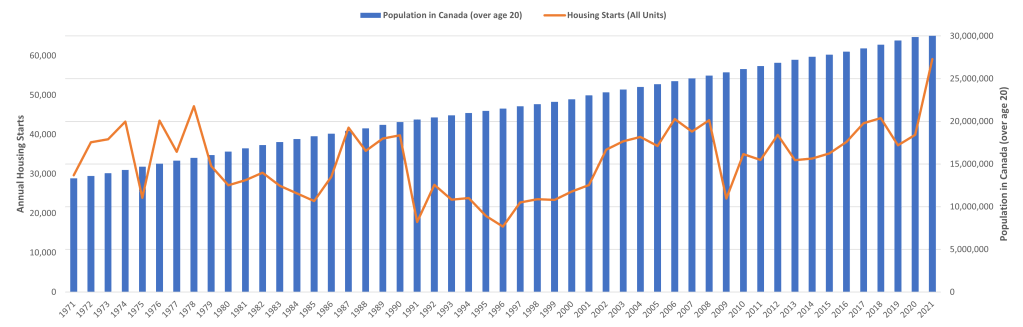
I believe that our problem stems from an equally simple principle from Economics 101, supply vs. demand. I put together a chart that shows the population growth of Canadians, over the age of 20, compared to the number of total housing starts per year. Our population over the age of 20 has grown from 13.3 million in 1971 to 30.2 million in 2021 but housing starts have remained very close to the average of 33,000 other than last year, where it hit an all time high of 59,000. There isn’t enough total units available for Canada’s population of potential home owners. The quoted data from housing starts includes single-detached, multiple family, semi-detached, row, apartment and other unit types. It is my opinion that we have a long road to go before the under-supply is corrected. The first step is to continue to achieve a higher annual growth rate of housing starts than the rate at which our population is growing. This can be a problem as home builders can get spooked easily and will build far less when the economy stumbles at all so only time will tell if they have learned from the errors of the past.
Going back to the title of this article, will high inflation lead to a real estate crash? I don’t believe it will. One thing that we have learned during the pandemic is that the modern government’s fiscal and monetary policies are much more accommodating than the restrictive policies of the 90’s era. We may see a period of time that the growth rate on the price of housing slows but I believe that this would be healthy for the overall market. There will be some years in the future that we experience price decreases too but that shouldn’t scare you, we have seen the average price of real estate fall 11% of the time from 1970 to 2022. All healthy markets should experience periodic years of negative returns and historical evidence has shown us that the health of the overall economy has far greater ramifications for the average price of real estate than the level of inflation or interest rates.
Home ownership isn’t a short-term transaction, it is something that is meant to be bought and held for very long periods of time. Like any market, I believe that trying to time your purchase for a potential future price fall is foolhardy. If the past has taught us anything, it is that growth should be expected over the long run and waiting on the sidelines may end up being more detrimental to your purchasing power than the actual drop in price (whenever it may occur).
The year has just started and Mr. Market did not take long to remind us about the level of volatility that we should expect when it comes to investing in the great companies of the world. Unfortunately, there is no other way to achieve the amazing long-term returns that come with equity investing other than sitting through the volatility that comes along with equity investing.
It’s never easy to sit through these periods of time but you may be making it harder on yourself than it needs to be. My advice is to stop watching your account values, turn off any financial news, and take advantage of the parts of your life that actually bring you enjoyment. This enjoyment may come from visiting with family and friends, cooking a homemade multi-course meal, or spending an afternoon in nature. The goal is to take your mind off of the financial part of your life because, no matter how long you stare at your computer screen, the sea of red will not magically turn green. Why do you care what happens with the total value of your investments from the morning to the afternoon, or from the start of the week to the end. If you are looking to provide yourself with a multi-decade income that will span the rest of your life then why do you care what happens in such short time frames?
If you are concerned, call your advisor. These are the times that you need them most and, since you are paying them either directly through fees/commissions or indirectly through trailer fees, you might as well hear some comforting reminders that should give you piece of mind. Your advisor can review your financial plan with you again, which should allow you to change your frame of thought to be more long-term. If your plan satisfied all your goals prior to this volatility then you are going to be okay after it concludes. I can’t tell you if the market has found its bottom yet, and no one can, so don’t believe any of the financial pundits on financial news networks that may say otherwise. Now is not the time to panic, now is the time to let your plan guide you to see past whatever is happening today.
I’ve found a couple different charts that should help. The first chart provides evidence that the longer you stay invested, the lower the variance that your average annual return will be. The second chart shows the repercussions of your actions if you tried to out-smart Mr. Market in the past.
J.P. Morgan puts together some amazing charts that help explain some of the most important investing principles. Here they have put together a chart that shows the returns of stocks (green), bonds (blue), and a 50/50 balanced portfolio (grey) over multiple length rolling periods from 1950 to 2020. All of the returns that you see listed above are average annual returns based on 70 calendar years.
The chart tells us that if we look at every year individually then investors have experienced a very wide variance of returns over the years:
Stocks have had annual returns as high as 47% and as low as -39%.
Bonds have had annual returns as high as 43% and as low as -8%.
A 50/50 Balanced Portfolio has had annual returns as high as 33% and as low as -15%.
Now, instead of looking at every year individually, let’s look at every 5-year rolling period available over that same 70 year time period:
Stocks have had average annual returns as high as 28% and as low as -3%.
Bonds have had average annual returns as high as 23% and as low as -2%.
A 50/50 Balanced Portfolio has had average annual returns as high as 21% and as low as 1%.
We can do the same for every 10-year rolling period:
Stocks have had average annual returns as high as 19% and as low as -1%.
Bonds have had average annual returns as high as 16% and as low as 1%.
A 50/50 Balanced Portfolio has had average annual returns as high as 16% and as low as 2%.
Lastly, and the best one of of all, we can look at every 20-year rolling period:
Stocks have had average annual returns as high as 17% and as low as 6%.
Bonds have had average annual returns as high as 12% and as low as 1%.
A 50/50 Balanced Portfolio has had average annual returns as high as 14% and as low as 5%.
What the data shows us is that over the course of the 70 years discussed, spanning from 1950 to 2020, there has never been any 5-year time period that a 50/50 Balanced Portfolio has lost money. As well, if you have the risk tolerance to invest 100% in stocks then the lowest annual average return experienced over any 20-year rolling period is 6% per year.
Trying to time the market consistently has been proven again and again to be nearly impossible but people always continue to try. If some of the smartest people in the world haven’t been able to accomplish it then I’d say that you’re better off taking their failed attempts as evidence.
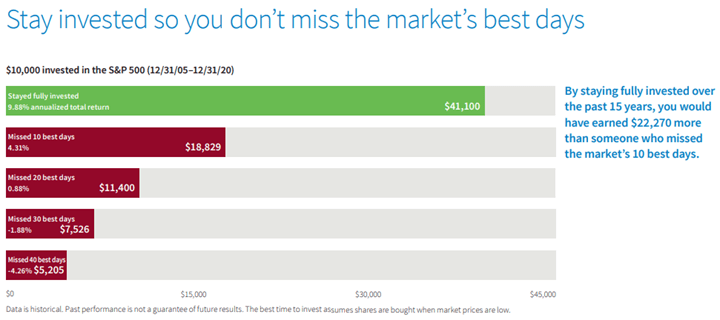
The chart above shows the S&P500 returns from the beginning of 2006 to the end of 2020 (15 years or 5,479 days). This time span also includes the Great Financial Crisis (GFC), which was the most serious global financial crisis since The Great Depression. During the GFC, the market was down as much as -49% and ended the calendar year with a total return of -38% (2008).
If you stayed the course and remained invested through these tumultuous times then you were rewarded with an annualized return of 9.88% per year.
If you just so happened to miss out on the best 10 days over that 5,479 day period then your annualized return dropped to 4.31% per year.
If you missed the best 20 days then you achieved a meager average of 0.88% per year.
If you missed the best 30 days then you lost any chance of positivity and experienced an average return of -1.88% per year.
Lastly, if you were unfortunate enough to miss out on the best performing 40 days over that 15 year time period then you experienced a negative average return of -4.26% per year.
Warren Buffett once wrote, “Someone’s sitting in the shade today because someone planted a tree a long time ago.” Think of it like this, if you keep moving a sapling around your yard to try to chase the sun as it moves across the sky everyday then the sapling will eventually die because it never gets a chance to take root. You must choose one spot to plant the young tree and let it grow. There may be seasons that the sapling might not get enough sun or rain but by choosing the right type of tree for the overall climate then you are going to be just fine and your sapling will be able to handle everything that nature throws at it. The person sitting in the shade may be your future-self or it may be the beneficiaries of your estate but, whomever it will be, they will be grateful that you were patient and allowed your sapling to grow into a ancient, towering tree.
I’ll end this article with a chart that spans 95 years, from 1926 to the end of 2021. During this time period, a $1 investment in the S&P500 grew to be worth over $7,500 today. For comparison, that same $1 investment in 3 month US Treasury Bills would have a value of $20, US Treasury Bonds would have a value of $85, and Baa Corporate Bonds would have accrued to a value of $542. Some of the events that transpired over this time period were monumental so take these into consideration when you worry about the events of today. Whatever happens, we will get through it. The only way to achieve the amazing long-term returns that I discussed is to remain invested, diversified, and to stay-the-course.