Will High Inflation Lead to a Real Estate Crash?

After a decade in different banking careers, I’ve heard many stories from older clients that lived through a long forgotten time of high inflation and high interest rates in Canada. Everyone seems to remember a story of someone that could not afford their mortgage payments, which resulted in them leaving their keys under the doormat so that the bank could collect on the debt. I haven’t actually heard from anyone that experienced this first-hand though. This may be like one of those tales that people heard a few times and it instilled such fear that it eventually became a memory in their own minds (one of those, “it happened to a friend of a friend” moments). Don’t get me wrong, I do think that some people lost their homes due to foreclosure but I believe that there may have been other, extraneous circumstances that assisted in causing it, aside from just high inflation and interest rates. Maybe someone might have lost their job or went through a marital separation and it was just an unfortunate perfect storm of variables that caused them to be unable to afford their debt load. Foreclosures happen every year, regardless of where inflation and interest rates are, but it is only a very small percentage of homes that are actually foreclosed on.

We are currently experiencing another high inflationary environment and most developed economies around the world are talking about increasing rates soon (if they haven’t started already). Let’s not forget that we are coming off of historic lows on both inflation and interest rates so when I say a “high inflationary environment,” it is in context to where we were in January 2021 (0.72%). The long term average inflation rate since 1970 is 3.95% and, as of January 2022, we are sitting at an inflation rate of 4.8%. I’ve read enough articles and opinions on the internet that suggest we are headed towards a Canadian housing market calamity due to our current environment so I wanted to try to actually test these theories based on historical data.

I could not find any historical Canadian foreclosure data but pricing pressures are fairly easy to understand. An excess supply of a good in any market should decrease the cost of said good. If foreclosures were as rampant as people suggest they were during the 1970’s and 1980’s then we should be able to see the excess supply in the Canadian market by decreases in residential housing prices during those years.

I found some data sets that provide the Bank Of Canada Overnight Lending Rate, Canada’s Annual Inflation Rate, and the Residential Price Index in Canada from January 1970 to January 2022 (or 52 years). The annual Canadian Residential Price Index has fallen only 6 times over the course of 52 years (or around 12% of the time). One instance occurred in the 80’s and it was a drop of -1.1% in 1984. The majority of the other price decreases came during the 90’s (1990, 1991, 1995, 1996, 1998) and were -2.9%, -0.9%, -3.9%, -2.6%, and -0.3% respectively. These drops were the result of a Canadian economic recession, which spanned from 1990-1991. The recession was said to have been caused by restrictive monetary policy by central bankers (as they did not want inflation to get back to late 1970’s and 1980’s levels) and the loss of consumer/business confidence due to the oil price spike from the Gulf War. The fact is, that during the course of the decade, the average price of housing still increased by 3.4% through the 1990’s. An investment in housing, just like an investment in the equity markets, should be looked at as a long-term investment. Anyone trying to predict the market and make out with a quick buck should also be aware that the predictive nature of any market decreases almost entirely when you look at short periods of time.

The largest annual average price decrease in Canadian real estate was -5.6% in 2009. This was during The Great Financial Crisis, caused by cheap credit and lax lending standards in the USA, and worldwide housing was put under a microscope during this period of time. This was the worst financial crisis since The Great Depression but Canadian real estate remained relatively unscathed due to its stringent and highly regulated banking system. We had no bank failures, no bailouts, and our recession was less severe than the United States. Canadian banks remained profitable, continued to pay dividends, and continued to lend.

Over the 52 years from 1970 to 2022, the average Canadian price of real estate has grown by 2,950% (or an average compound return of about 9% per year). It has allowed Canadians access to another wealth creation strategy and to diversify from solely relying on worldwide equity markets. Our southern neighbors have had about half of our average price appreciation, the US House Price Index has only increased by a total of 800% from 1975 to 2022 (compared to Canada’s 1,515% over that same time period).

Don’t get me wrong, I completely understand why people believe the underlying financial principle that high inflation should lead to higher interest rates (as this is usually the Bank of Canada’s first arrow in their quiver to calm periods of higher inflation). Higher interest rates should decrease the value of the real estate. This is what financial principles tell us but the real world rarely cares about what you learned in Economics 101. I’ve put together a chart that shows multiple periods when Canadian interest rates were increasing and what was the effect on the Canadian Real Estate Price Index. I’ve also added in the inflation rates at the beginning and end of each period as well. During the nine increasing rate environments shown below, only one period of time (1994-1995) resulted in a decrease in the average price of Canadian real estate (-4%) and I’d argue that it had more to do with the overall Canadian economy trying to bounce back from a recession than the actual interest rate increases.

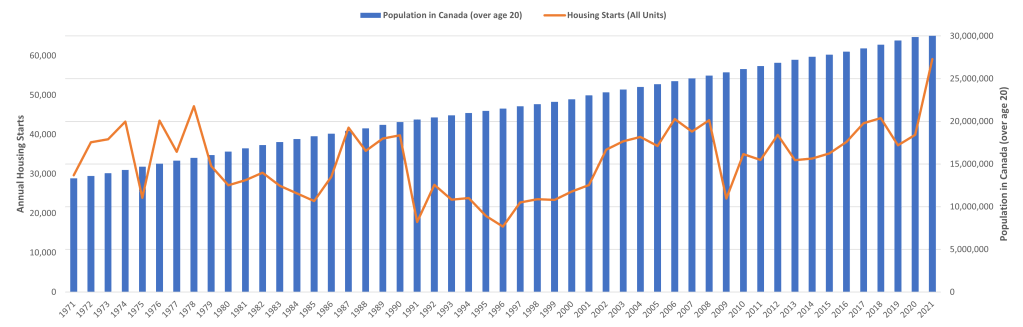
I believe that our problem stems from an equally simple principle from Economics 101, supply vs. demand. I put together a chart that shows the population growth of Canadians, over the age of 20, compared to the number of total housing starts per year. Our population over the age of 20 has grown from 13.3 million in 1971 to 30.2 million in 2021 but housing starts have remained very close to the average of 33,000 other than last year, where it hit an all time high of 59,000. There isn’t enough total units available for Canada’s population of potential home owners. The quoted data from housing starts includes single-detached, multiple family, semi-detached, row, apartment and other unit types. It is my opinion that we have a long road to go before the under-supply is corrected. The first step is to continue to achieve a higher annual growth rate of housing starts than the rate at which our population is growing. This can be a problem as home builders can get spooked easily and will build far less when the economy stumbles at all so only time will tell if they have learned from the errors of the past.

Going back to the title of this article, will high inflation lead to a real estate crash? I don’t believe it will. One thing that we have learned during the pandemic is that the modern government’s fiscal and monetary policies are much more accommodating than the restrictive policies of the 90’s era. We may see a period of time that the growth rate on the price of housing slows but I believe that this would be healthy for the overall market. There will be some years in the future that we experience price decreases too but that shouldn’t scare you, we have seen the average price of real estate fall 11% of the time from 1970 to 2022. All healthy markets should experience periodic years of negative returns and historical evidence has shown us that the health of the overall economy has far greater ramifications for the average price of real estate than the level of inflation or interest rates.

Home ownership isn’t a short-term transaction, it is something that is meant to be bought and held for very long periods of time. Like any market, I believe that trying to time your purchase for a potential future price fall is foolhardy. If the past has taught us anything, it is that growth should be expected over the long run and waiting on the sidelines may end up being more detrimental to your purchasing power than the actual drop in price (whenever it may occur).

Want to chat more? Email me at info@financerx.ca

Sources :

https://fred.stlouisfed.org/series/QCAN628BIS

https://fred.stlouisfed.org/series/USSTHPI

https://wowa.ca/bank-of-canada-interest-rate

https://www.macrotrends.net/countries/CAN/canada/inflation-rate-cpi

https://www150.statcan.gc.ca/t1/tbl1/en/tv.action?pid=1710000501

It’s Time-In, Not Timing.

The year has just started and Mr. Market did not take long to remind us about the level of volatility that we should expect when it comes to investing in the great companies of the world. Unfortunately, there is no other way to achieve the amazing long-term returns that come with equity investing other than sitting through the volatility that comes along with equity investing.

It’s never easy to sit through these periods of time but you may be making it harder on yourself than it needs to be. My advice is to stop watching your account values, turn off any financial news, and take advantage of the parts of your life that actually bring you enjoyment. This enjoyment may come from visiting with family and friends, cooking a homemade multi-course meal, or spending an afternoon in nature. The goal is to take your mind off of the financial part of your life because, no matter how long you stare at your computer screen, the sea of red will not magically turn green. Why do you care what happens with the total value of your investments from the morning to the afternoon, or from the start of the week to the end. If you are looking to provide yourself with a multi-decade income that will span the rest of your life then why do you care what happens in such short time frames?

If you are concerned, call your advisor. These are the times that you need them most and, since you are paying them either directly through fees/commissions or indirectly through trailer fees, you might as well hear some comforting reminders that should give you piece of mind. Your advisor can review your financial plan with you again, which should allow you to change your frame of thought to be more long-term. If your plan satisfied all your goals prior to this volatility then you are going to be okay after it concludes. I can’t tell you if the market has found its bottom yet, and no one can, so don’t believe any of the financial pundits on financial news networks that may say otherwise. Now is not the time to panic, now is the time to let your plan guide you to see past whatever is happening today.

I’ve found a couple different charts that should help. The first chart provides evidence that the longer you stay invested, the lower the variance that your average annual return will be. The second chart shows the repercussions of your actions if you tried to out-smart Mr. Market in the past.

J.P. Morgan puts together some amazing charts that help explain some of the most important investing principles. Here they have put together a chart that shows the returns of stocks (green), bonds (blue), and a 50/50 balanced portfolio (grey) over multiple length rolling periods from 1950 to 2020. All of the returns that you see listed above are average annual returns based on 70 calendar years.

The chart tells us that if we look at every year individually then investors have experienced a very wide variance of returns over the years:

  • Stocks have had annual returns as high as 47% and as low as -39%.
  • Bonds have had annual returns as high as 43% and as low as -8%.
  • A 50/50 Balanced Portfolio has had annual returns as high as 33% and as low as -15%.

Now, instead of looking at every year individually, let’s look at every 5-year rolling period available over that same 70 year time period:

  • Stocks have had average annual returns as high as 28% and as low as -3%.
  • Bonds have had average annual returns as high as 23% and as low as -2%.
  • A 50/50 Balanced Portfolio has had average annual returns as high as 21% and as low as 1%.

We can do the same for every 10-year rolling period:

  • Stocks have had average annual returns as high as 19% and as low as -1%.
  • Bonds have had average annual returns as high as 16% and as low as 1%.
  • A 50/50 Balanced Portfolio has had average annual returns as high as 16% and as low as 2%.

Lastly, and the best one of of all, we can look at every 20-year rolling period:

  • Stocks have had average annual returns as high as 17% and as low as 6%.
  • Bonds have had average annual returns as high as 12% and as low as 1%.
  • A 50/50 Balanced Portfolio has had average annual returns as high as 14% and as low as 5%.

What the data shows us is that over the course of the 70 years discussed, spanning from 1950 to 2020, there has never been any 5-year time period that a 50/50 Balanced Portfolio has lost money. As well, if you have the risk tolerance to invest 100% in stocks then the lowest annual average return experienced over any 20-year rolling period is 6% per year.

Trying to time the market consistently has been proven again and again to be nearly impossible but people always continue to try. If some of the smartest people in the world haven’t been able to accomplish it then I’d say that you’re better off taking their failed attempts as evidence.

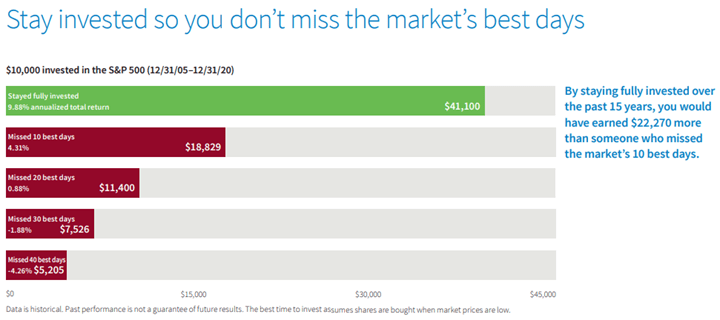
The chart above shows the S&P500 returns from the beginning of 2006 to the end of 2020 (15 years or 5,479 days). This time span also includes the Great Financial Crisis (GFC), which was the most serious global financial crisis since The Great Depression. During the GFC, the market was down as much as -49% and ended the calendar year with a total return of -38% (2008).

  • If you stayed the course and remained invested through these tumultuous times then you were rewarded with an annualized return of 9.88% per year.
  • If you just so happened to miss out on the best 10 days over that 5,479 day period then your annualized return dropped to 4.31% per year.
  • If you missed the best 20 days then you achieved a meager average of 0.88% per year.
  • If you missed the best 30 days then you lost any chance of positivity and experienced an average return of -1.88% per year.
  • Lastly, if you were unfortunate enough to miss out on the best performing 40 days over that 15 year time period then you experienced a negative average return of -4.26% per year.

Warren Buffett once wrote, “Someone’s sitting in the shade today because someone planted a tree a long time ago.” Think of it like this, if you keep moving a sapling around your yard to try to chase the sun as it moves across the sky everyday then the sapling will eventually die because it never gets a chance to take root. You must choose one spot to plant the young tree and let it grow. There may be seasons that the sapling might not get enough sun or rain but by choosing the right type of tree for the overall climate then you are going to be just fine and your sapling will be able to handle everything that nature throws at it. The person sitting in the shade may be your future-self or it may be the beneficiaries of your estate but, whomever it will be, they will be grateful that you were patient and allowed your sapling to grow into a ancient, towering tree.

I’ll end this article with a chart that spans 95 years, from 1926 to the end of 2021. During this time period, a $1 investment in the S&P500 grew to be worth over $7,500 today. For comparison, that same $1 investment in 3 month US Treasury Bills would have a value of $20, US Treasury Bonds would have a value of $85, and Baa Corporate Bonds would have accrued to a value of $542. Some of the events that transpired over this time period were monumental so take these into consideration when you worry about the events of today. Whatever happens, we will get through it. The only way to achieve the amazing long-term returns that I discussed is to remain invested, diversified, and to stay-the-course.

Want to chat more? Email me at info@financerx.ca

Are You Smarter Than a Hedge Fund Manager?

We are living through a period of time that there is unfathomable amounts of data at our fingertips and most people in the western world have instant access to this data through a computer or a smart phone. This data can be incredible helpful in certain areas of our lives but it also can hinder.

The information that we perceive to be beneficial when it comes to making investment decisions, like selling out of an investment just to buy it back later, can hinder our long term return potential. This results in an investor’s returns lagging the actual total return that their investments can earn. Our choices of when to try to out-smart and time the market takes away from the return that the investments can provide with a simple buy-and-hold strategy. Let’s not forget that selling is only one half of this type of trade, you also have to be correct on when to get back in.

I have included a list (see below) that shows the 2021 returns of thirty-eight hedge funds in the USA. These are some of the best and brightest minds on Wall Street, whom have countless staff at their disposal and have access to any information that they perceive to be necessary to make investment decisions. As a comparison, the S&P500 stock index rewarded passive investors with a 2021 total return of 28.71%.

As you can see from the list, three out of the entire list actually performed better than the index… THREE! Bear in mind that these hedge fund managers are paid on the two and twenty fee arrangement usually where they charge 2% per year on the total assets that you bring them AND they also take 20% of the profits made by the fund above a certain predefined benchmark. Their investment strategies are far from passive index investing but just because you have some fancy algorithm or a team of analysts doesn’t mean that you are smarter than the market. As well, this only covers one calendar year (2021) and no one knows what 2022 holds but this should show you that even the smartest people on Wall Street don’t have an idea either.

Looking at your 2021 year-end statement returns, I’m sure that a lot of you can give yourselves a pat on the back for beating a good number of the market professionals listed above. As well, I hope that it continues to reiterate my thoughts on prudent diversified investment management being a dime-a-dozen service and financial planning being the key to your future success.

Here are the steps to attain financial success:

  1. Create a Vision
  2. Transform Your Vision into a Quantitative Plan
  3. Invest Accordingly to Achieve Your Vision
  4. Revisit the Plan to Track Progress & Update as Required

If you need help with creating a personalized vision or any other of the steps listed then feel free to reach out to me at info@financerx.ca.

New Year Checklist

As the calendar flips over another year, it should signify a time to do a quick financial & estate check.

The first thing to check is the beneficiaries on your investment accounts, company pensions, and insurance policies. This is something that should be updated whenever something materially changes in your life but, you know how it goes, usually you are too busy experiencing that change to actually do anything at the time. Well, now is the time to verify that everything is set up correctly for the estate goals that you envision. This can make a huge difference if, heaven forbid, something was to happen to you and your beneficiary designations were not set up correctly. It could mean that certain assets get probated (effectively losing around 1.4% to the government) or it could mean that assets get awarded to an ex-spouse or someone else that may not be in your life anymore. It’s fairly simple and only requires a phone call to your HR department / advisor(s).

Next, look at your investments and try to understand how much you are actually paying in annual fees. Every type of managed solution, such as segregated funds, mutual funds and exchange traded funds (ETFs), charge an embedded fee. An embedded fee is one that you don’t actually see on your statement but it comes out of your investment returns. The fee for mutual funds and ETFs is known as a management expense ratio (MER) and can differ vastly from product to product, with costs as low as a few basis points (0.03%) to a few percent per year. If there is a way to save on fees then you are giving your assets a bump up in the annual return that you will experience going forward. While we are on the subject of fees, if your assets are currently being managed by an advisor then make sure that you are getting your fee’s worth of value. Asset management is a dime-a-dozen these days and you can find many lower cost alternatives in the market. I can not stress it enough; the value of an advisor comes in the form of helping you create a vision for your future, showing you how you are going to achieve your vision, and continuing to review if you are on track or if any changes need to be made as time passes and your life changes.

How about maximizing your contributions in certain accounts? If you are maximizing the annual contributions to your Tax Free Savings Account (TFSA) and a child’s Registered Education Savings Plan (RESP) then a new year marks new eligible annual contributions. For 2022, the Government of Canada has allowed an additional $6,000 contribution to TFSAs. For the RESP, the maximum annual contribution to ensure that you are maximizing the Canadian Education Savings Grant is $2,500 per beneficiary (unless you are making up for a previously missed year and then it is $5,000). More information on the RESP can be found on one of my earlier posts, which I have linked to here.

Lastly, to circle back to where this article started, has anything materially changed in your life that would require you to update your Will and/or Power of Attorney? There could have been a death in the family, a falling out, or maybe a new birth. Whatever may have happened, it may not require any changes to your existing estate documents but these documents should be reviewed every couple years to ensure that no changes are required. I know that most people hardly look at these documents after the day they are created at the lawyer’s office so now is your chance.

This checklist doesn’t take much time but it can mean a substantial difference in the outcome of your financial future so take a minute to review the things that I have discussed and it’ll give you piece of mind for another lap around the sun.

Do you have any questions? Email me at info@financerx.ca

Deferring Property Tax in British Columbia

During the Christmas break, every homeowner across BC would have received their new property assessment for 2022. Everyone that I have spoken with is awestruck by the enormous gains that they have experienced (on paper), which will only increase their upcoming property tax bill in July. Homeowner’s in Greater Victoria are experiencing an average assessed value increase of 22 to 35 percent. The Lower Mainland is comparable, with the average gains being between 10 to 30 percent. The average long-term gain across all of BC, going back to the early 80’s, is an average annual gain of 6.2 percent per year.

Money can be tight if you are retired and living on a fixed budget, and even the B.C. Government understands this, which is why deferring your property tax can be a very beneficial solution to increasing your annual cash flow. I actually recommend that most of my clients participate in this program, even if money isn’t tight, because not often does the government let you loan money with such attractive terms.

To keep it easy to understand, the criteria to defer your property taxes is quite simple. One owner of the home must be at least 55 or older during the current calendar year. There are other ways that you can become eligible through disability or by the loss of your spouse but feel free to reach out to me directly if you would like more information on the other ways to become eligible.

Once the government approves you for the Property Tax Deferral Program then you will still have to claim your homeowner’s grant annually because the deferment does not include the home owner grant. What makes this program so attractive is the fact that the government only charges simple interest at a rate not greater than 2% below the prime lending rate (currently 2.45%). This means that, currently, you would pay 0.45% interest on the property tax that you defer and, unlike a credit card or loan balance, the interest that is charged is simple interest. Simple interest means that the interest is only charged based on the amount loaned but it does not compound, so your interest does not build interest on itself. As well, there is a small fee of $60 in the initial year of set up and a rolling fee of $10 for every year that you continue to participate in the program. These fees are negligible in the long run so do not worry about them.

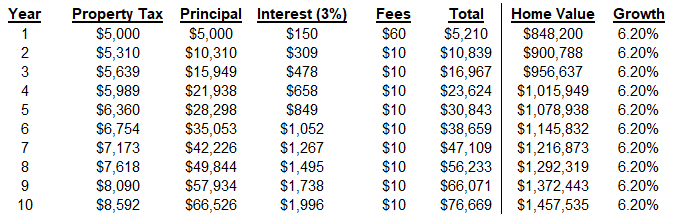
Let’s look at this with a real-world example. The average home across all of B.C. is about $850,000 and the average long-term growth rate (since the early 80’s) in B.C. has been around 6.2% per year. I am going to assume that the annual growth of your property tax bill also goes up by 6.2% per year.

In this example, after a decade of deferring their property tax, this person have amassed a $68k debt to the government but their property value has increased by $610k. This means that you have been able to keep an additional $68k for use in your own life over a decade to do the things that you have always wanted to do and all you have to do is pay back the government when you sell your property (or your estate sells your property).

Now, we all know that interest rates are set to go up so we can recreate the same example but let’s assume that the prime rate in Canada was as high as 5% over the next decade. If the prime rate was at 5% then the deferment loan would be charged an annual interest rate of 3%. This is only for use in our example but I can not stress enough that the chance of this happening (in the near term) is very low.  

Even with a heightened interest rate, you can see that it doesn’t drastically increase the amount that you actually owe. This is due to the key principle that I discussed earlier, simple interest.

As you can see from the examples, the Property Tax Deferment Program in B.C. is one that I stand behind and one that I encourage everyone (over the age of 55) to participate in. You have worked your entire life to use the money that you have put away for your own enjoyment so make sure that you don’t let this opportunity pass you by.

Click Here for the government website for the deferment program.

Do you have any questions about the strategy discussed? Email me at info@financerx.ca

The Grass isn’t Greener

We see it all the time . . . people’s lives through the lens of Instagram or other social media platforms and we believe that it is a direct view of their lives. The same can be said about investment performance, we hear that someone has exorbitant returns and we believe that we should experience the same thing even though you know nothing about their asset allocation (percentage in stocks versus bonds) or what they are invested in.

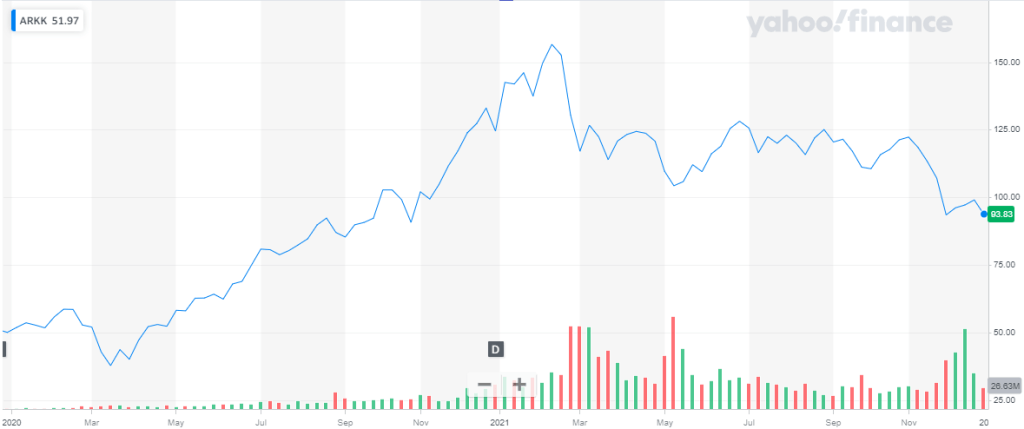
People tend to scream from the rooftops when they experience large returns but you don’t hear as much of a whisper when their portfolio is in freefall. Think back to 2020 and how much you heard about the Ark Invest’s Disruptive Innovation ETF (ARKK), which provided a massive annual return of 152%. The fund’s manager, Cathie Wood, seemed to have her finger on the pulse on everything that was happening such as the Work-From-Home and Electronic Vehicle trends. Now, fast forward to today and ARKK has whipsawed and has a 2021 year-to-date return of -25% (when the S&P500 has returned 27% in the same time period). We haven’t heard any of the usual market pundits say much about Cathie this year and the sad thing is that a lot of retail investors were too late when they invested in ARKK so they only experienced the 2021 negativity.

It may feel like the right move to change your investment strategy and jump on the most recent investment trends but if you’ve heard about it then it is probably too late. Changes to your investment strategy should only be made if something changes materially in your life.

We try to teach the younger generation about fads and how a fad usually falls out of favor as quickly as it came in so why would you gamble your life savings on one?

Want to discuss your Lifelong Financial Plan? Email me at info@financerx.ca

Forecasts & Fortune Tellers

With the end of the year fast approaching every analyst, research, and investment firm is rushing to get their 2022 Outlooks into the hands of advisors and investors. There will be predictions about everything including where interest rates and inflation are headed, what is going to happen in the stock and bond markets, and which countries around the world will flourish or flounder. These forecasts have the same accuracy as Miss Cleo’s psychic predictions that we all remember from TV programming in the 90’s or the famous Zoltar Fortune Teller machine from your local Spring Fair.

With more-and-more people around the world being connected by the internet everyday, the world changes quickly. The amount of information that gets exchanged per second is hard to wrap your head around, and it is only getting faster and faster, but this doesn’t stop economists and market strategists from issuing ‘precise’ forecasts for the year ahead. A few may be right but this is simply due to chance because of the vast number of firms that come out with these predictions. It’s like choosing lottery numbers, if enough people buy lottery tickets then someone will ‘predict’ what the numbers on the upcoming draw will be.

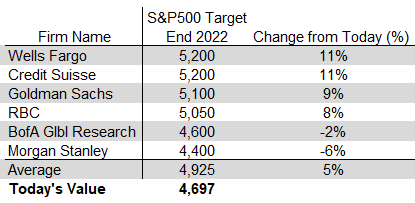
Reuters has compiled 6 of the major Wall Street firm’s predictions for the end of 2022 S&P500 target and they are as follows (from highest to lowest).

At the time of this writing, the S&P500 currently has a value of 4,696.56 meaning that the average prediction across these firms sees the S&P500 increasing by about 5%. The highest predictions are suggesting a 11% increase from today’s values and the lowest prediction is suggesting a negative 6% return. Will any of them be correct? Maybe, but no one can predict what will happen in the market tomorrow, let alone the value that it will have in over one year’s time.

I want to rewind a couple of years, which would have been December 2019, and I want to bring up some of the headline predictions for 2020:

RBC – New Year 2020 outlook : Boosting equity allocation as economy stabilizes, downside risks diminish

Wells Fargo – Recession risks in the rearview mirror, but a correction could be coming

BofA – 5 key trends will drive stocks next year

Goldman Sachs – 2020 election outcome a risk to equities

Credit Suisse – Cyclical leadership

Morgan Stanley – U.S. remains our least preferred region

Not a single firm suggested that a global pandemic would shut down the entire world. No one said that we would all be forced to shelter in our homes and hope that we did not succumb to a new type of corona virus. Not one headline about the S&P500’s shortest bear market in history (1.2 months), starting on February 20 and ending on April 7, and that we would experience some of the largest daily percentage losses in history (-12% on March 16 and -9.5% on March 12). Regardless of the bear market, the S&P500 still went on to achieve a positive return of 16% for the year. No one is holdings these firms accountable for missing this major world event because no one can expect anyone to predict something that is seemingly unpredictable, no matter their level of expertise on any subject. That being said, I still have friends and clients that ask me to pass along these predictions as I receive them, like it is something that they can use to make their own predictions for the upcoming year and turn them into better investors. I believe that these will actually leave you worse off as an investor because you’ll have some false confidence that you know what’s coming. The best thing you can do is realize and embrace the fact that the world is unpredictable, resulting in the markets being unpredictable in short periods of time.

The only solution that I have found to provide any sort of prediction of what the future holds is through long-term financial planning. Don’t try to forecast one year ahead because any funds that are required within one year shouldn’t be invested, unless you can afford the potential loss of needing the funds when the market is down. Forecast ten or twenty years and use long-term multi-decade averages for the assumptions within the plan. The average’s for the assumptions should encompass different periods of market & economic cycles. Creating the plan is step one, but the job is far from over. Planning is only valuable when it is revisited to quantify where you stand based on your goals. Are you still on track? Has anything changed in your life that requires a re-work of the plan? We know that the world is unpredictable and our lives are no different so make sure that you are focusing on the right tools to forecast your own personal success.

Want to chat about it? Email me at info@financerx.ca

Is Your Wallet Shrinking?

If you have watched or read the news lately then you will have heard about the “unprecedented” inflation as of late and I wanted to break this down a little. Inflation simply means the rate at which a dollar loses value over time. This is shown in the increase of the average price level of a basket of selected goods and services in an economy over some period of time.

StatsCanada released their Consumer Price Index (Inflation) report for October and, across Canada, CPI rose 4.7% on a year-over-year basis in October, up from 4.4% in September. This was the largest gain since February 2003. Energy prices were up 25.5% year over year in October, primary driven by an increase in gasoline prices. Passenger vehicles remained high compared with October 2020, increasing 6.1% year over year amid a global shortage of semiconductor chips. In addition, prices for passenger vehicles, accessories and supplies rose 3.6% year over year. Prices for meat products (+9.9%) continue to rise in October, as fresh or frozen beef (+14.0%) and process meat (+8.5%), which includes bacon (+20.2%), put upward pressure on prices. Labour shortages that have slowed down production, ongoing supply chain challenges and rising prices for livestock feed continue to factor into higher prices for meat. In British Columbia, this year we had the highest increase in property tax (+5.6%) compared to the other provinces. This increase in property tax was in part because of higher assessment values.

 To be able to assess whether this is high or low compared to other years, I wanted to look at the CPI in British Columbia over the last 5 years. What the data tells us is that inflation between 2019 to 2020 was almost zero (0.5%) and inflation from 2020 to 2021 was 3.8% so we are simply playing catching up to the 5 year average (2.4%). Gasoline saw the highest percentage change of 33% from 2020 to 2021 but it also saw the most percentage loss (-18%) from 2019 to 2020. Energy, which includes electricity, natural gas, fuel, etc., was the second highest percentage change of 21% from 2020 to 2021 but it also saw the second most percentage loss (-10%) from 2019 to 2020.

We can eliminate Gasoline and Energy from the equation and things seem to be pretty normal, spanning between 0.1% (Clothing and Footwear) to 5.8% (Goods in general).

Want to chat about it? Email me at info@financerx.ca

Investing & the Game of Pool

When it comes to discussing retirement with clients I always like to utilize real world examples. One example that came to mind recently is how investing in retirement is like a game of pool. When you are investing and are reliant on your investment income then the stakes are considerably higher than when you still have career income and are building your net worth.

When the stakes are high, you must ensure that you take time to be accurate and to line up your shots. You can’t just “shoot from the hip” and hope that you are successful. In investing, this means that you (or whomever is managing your assets) is doing their due diligence when picking your investments. You may get lucky once or twice but without a prudent investment strategy then you are playing Russian Roulette, especially when you have to invest through countless economic cycles and ensure that your funds last for multiple decades. You might not be able to recover if you have too much exposure to one company that ends up going out of business or one sector that falls out of favor for a long period of time so the key thing here is to ensure that you are diversified into various companies, sectors, and countries. Take your time to ensure that you are accurate and sure of every move.

During a high-stakes game of pool, it is easy to let our emotions get the best of us. When our emotions run high and we get frustrated then we have a heightened risk of making costly mistakes. We know that the best thing we can do for our game is to remain calm and patient but it’s easier said than done, and it is exactly the same for investing. We can experience market-wide losses and people are ready to sell everything and go to cash rather than staying calm and patiently waiting for the market to recover. Generally speaking, if the money is needed in the short-term then you shouldn’t be investing that portion anyway. Be patient and don’t throw in the towel early, there is still lots of game to be played. 

In investing and pool, we tend to have a short-term memory. You may have played well up to now but that doesn’t mean that your streak will continue. If the market has gone through a period of time with lower than average negative volatility then we tend to think that it will continue into the future and we are surprised when it doesn’t (see my article, “It’s Not a Matter of If, It’s When…”). If the market goes through a period of time that we see substantial negative returns then we still seem to think that it is going to continue rather than recover, even when a recovery is actually more probable. During short periods of time, we may find ourselves on hot streaks and on cold streaks but in the long term we are no better or worse than our asset allocation and, over time, our skill at pool and investing will always regress back towards our own average.

The winner will always be the one that has avoided making the most mistakes. Take your time lining up your shots, don’t let your emotions get the better of you, and ensure that you don’t let your past experiences cloud your future judgement. If you have a financial plan and remember these tips then you should have no problem “running the table.”

Want to chat about it? Email me at info@financerx.ca

The Bank of Mom & Dad : Open For Business?

Housing affordability in Canada is always a debated topic. On one side of the argument you have the older generation, who are already home owners. This population has been able to add to their wealth simply by owning the home in which they have lived for decades. On the other side of the argument you have the younger generation, who are trying to achieve home ownership in one of the most expensive housing markets in the world. It can seem like an absolutely daunting experience to start to save for a down payment while you are paying rent and your other bills.

I thought that the best way to present this data in the form of a line graph. I sifted through as many databases on the internet as I could in regards to historical figures. There is some variance in the numbers across multiple databases but the trend remains the same across the board; total before-tax household income is nowhere near keeping pace with the incredible pace of growth in Canadian real estate.

A lot of media attention has been given to “The Bank of Mom & Dad” lately and the fact that “roughly 30 per cent of first-time homebuyers and nearly 9 percent of existing homeowners received financial help from family this past year to purchase a home.” “First-time buyers received an average gift of $82,000, while “mover-uppers” were gifted a whopping average of $128,000 in September 2021.” Families are looking to give their children a helping hand to start their life and it can be a huge help, like starting a marathon by being shot out of a cannon rather than the traditional method of jogging with the pack. It can be a huge help but that help doesn’t come without risks. There are several ways that all or a portion of those funds can vanish so I believe that knowing and understanding the risks before hand will help determine whether you are willing to take that risk.

Risk 1: Are you sure that you will have enough for the rest of your life? This is probably the greatest risk of anyone in retirement today and I’ve talked about this in my past article (The Invisible Thief). People are living longer than ever and inflation will be the largest drag on their portfolio over the rest of their lifetime. More and more pensions are becoming non-indexed or are based on employee contributions (like defined contribution pension plans) so it will be up to you to ensure that your income accounts for inflation. With the average Canadian family earning around $100,000 gross per year, Canada’s long-term average inflation rate of 3.52%, and the average length of retirement of around 20 years, you better be prepared to double your income over those 20 years to maintain your purchasing power.

Risk 2: Once the gift has left your bank account and is provided to your child then it becomes their property. This means that your funds won’t be protected if your child (or their spouse) should have any issues with creditors or they experience a marital breakdown. One option to minimize the proportion of funds that the creditors or an angry spouse can get is to co-sign on the mortgage but it still may result in the home being sold if there isn’t enough funds to satisfy the court order. Co-signing on the mortgage can also result in the property losing a portion of its principal residence designation for your child, which is one the greatest gifts of home ownership in Canada, so this may not be the best option.

Risk 3: Fairness remains a big thing when it comes to parents treating children equally. If you have decided to help one child now then you can add a clause in your will that will consider any gifts provided during your lifetime as part of their portion of your estate upon your passing. This is known as a hotchpot clause.

Rather than an outright gift, how about using a promissory note? A promissory note is an enforceable promise to pay back a loan or debt. The note will have a repayment schedule, provisions for interest and the applicable rate, consequences for missed payments, and parents may even wish to register their interest on the title of the child’s home. All parties involved will need to sign the note and it should be witnessed and/or notarized. This ensures that your interest in the property remains your interest with legal documentation to support that. If your intention is to eventually forgive the note in the future then this is something that can be addressed in your will. You should always seek legal counsel before any money changes hands and ensure that you understand the risks involved or if any changes need to be made to your estate documents.

Want to chat about it? Email me at info@financerx.ca